Agency Ad Creative Research Workflow
For performance marketing agencies, competitive ad creative research is a service differentiator. The agencies that do it systematically, not just when a client asks, deliver better creative strategy, brief more confidently, and build stronger long-term client relationships.
This guide covers the complete agency workflow for ad creative research: from onboarding a new client competitive research to delivering monthly intelligence that drives creative decisions.
Direct answers
Quick answers for this topic
What is competitor video ad tracking?
Competitor video ad tracking is the process of monitoring publicly visible competitor video ads, recording hooks, offers, formats, CTAs, landing page context, and review dates, then using those notes to guide original creative planning without claiming private performance data.
What is the best way to organize ad research?
The best way to organize ad research is to use a consistent workflow: define the competitor set, capture public creative signals, tag each hook and offer, add landing page notes, choose a next action, and summarize meaningful changes every week.
Related workflow links
Continue the research workflow
Why Agency Ad Creative Research Workflow Matters for Your Team
Agency Ad Creative Research Workflow addresses a specific gap that many agency workflows teams encounter: the gap between knowing that competitive research is valuable and actually having a research workflow that produces consistent, actionable intelligence without becoming a time-sink. The teams that get this right treat agency ad creative research as a repeatable process rather than a one-time project — which is why the structure matters as much as the tool.
When a team starts treating agency ad creative research as infrastructure rather than an occasional task, several things change. The research becomes more consistent because the workflow has a defined cadence. The intelligence becomes more useful because findings are organized in a searchable structure rather than scattered across screenshots and notes. The briefs improve because they are grounded in pattern-level observations from the research library rather than whatever creative was seen most recently.
This distinction — infrastructure vs. project — is the difference between teams that build genuine competitive intelligence over time and teams that periodically rediscover what their competitors are doing without ever accumulating an organized knowledge base.
A Practical Framework for Getting Started
Whether Agency Ad Creative Research Workflow is new to your team or an existing process that needs better structure, a practical starting framework has five components:
1. Define what you are researching: which competitors, which platforms, which specific signals (hooks, offers, formats, landing pages, or all of the above). A clear scope prevents the research from becoming too broad to review consistently.
2. Set up a monitoring cadence that matches your team's production cycle. Weekly reviews work for active paid social programs. Monthly reviews are better for stable categories or teams with longer creative production timelines.
3. Use consistent classification tags for every entry in your research library. Hook patterns, offer structures, and creative formats should use the same taxonomy across all entries. Consistency is what makes the library searchable for pattern analysis.
4. Connect every observation to a next step: brief a differentiated test, monitor for pattern development, report to stakeholders, or archive as noise. Research without a decision framework grows without producing value.
5. Review the system quarterly: which competitors are still relevant, which classification categories are useful, and whether the output formats still match what the team needs.
- →Start with the specific competitors and signals that matter most for your current brief and testing cycle
- →Use consistent tags for hook patterns, offer structures, and creative formats across all entries
- →Connect each observation to a decision: brief, monitor, report, or archive
- →Review and refine the system quarterly to keep it aligned with team needs
Manual vs. Structured: How Agency Ad Creative Research Workflow Changes Your Workflow
Most teams start Agency Ad Creative Research Workflow with a manual process: checking competitor pages, saving screenshots, and discussing findings in meetings or chat threads. This approach works for a one-off review but breaks down when the team needs consistent intelligence across multiple competitors, clients, or review periods.
The manual approach
Manual competitor research typically involves checking three to five competitor profiles or the TikTok Creative Center on a weekly basis, saving interesting ads to a folder or Notion page, and discussing findings in a team meeting or chat thread. The manual approach works for initial discovery but has structural limitations: no automated alerts mean new creative can go unnoticed between manual checks, screenshots lack consistent classification tags needed for pattern analysis, findings are hard to search or compare across review periods, and the research output is often a conversation rather than a structured deliverable.
The structured approach with VideoIntelHQ
A structured approach using VideoIntelHQ replaces manual checking with automated competitor monitoring. New creative is captured as it appears, classified with consistent hook and offer tags, and organized into a searchable library that grows more valuable over time. Weekly summaries consolidate the most important observations for each competitor or client account, and the research library supports longitudinal analysis that manual methods cannot match. The structured approach does not require more time — it requires different time allocation. Instead of spending two hours manually checking competitor profiles, the team spends thirty minutes reviewing organized weekly summaries and tagging new entries into the library. The remaining ninety minutes goes into analysis, brief writing, and strategic discussions rather than data collection.
What Agency Clients Actually Want in Competitive Reports
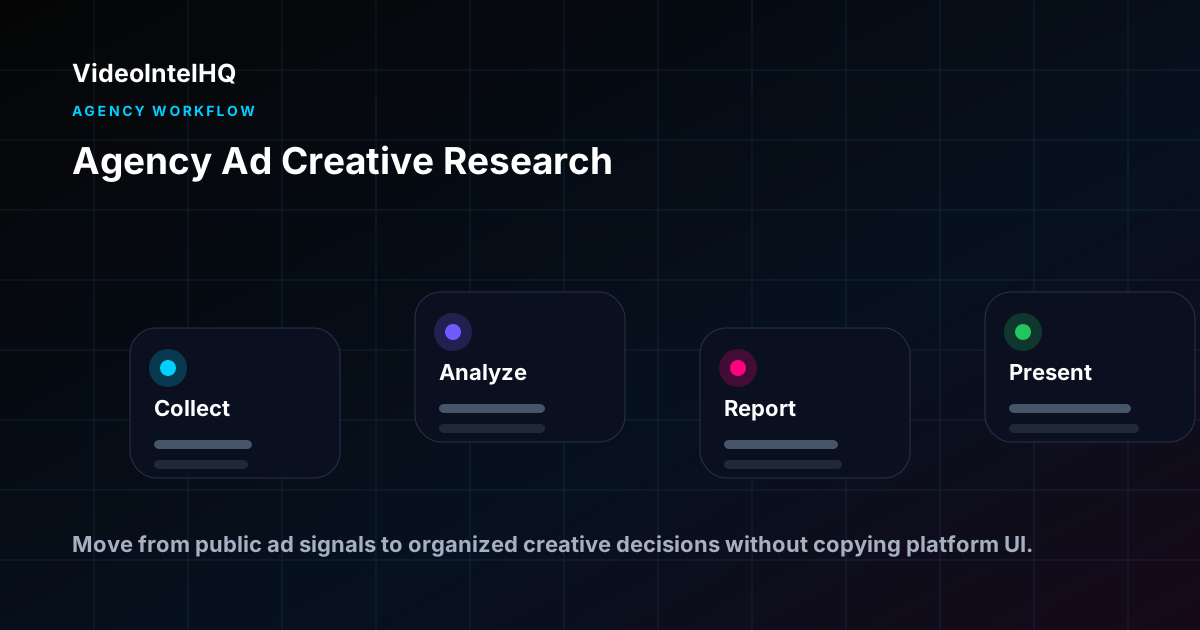
There is a consistent gap between what agencies find interesting in competitive research and what clients find valuable. Agencies often focus on the breadth of creative discovered — the volume of ads reviewed, the number of competitors covered, and the range of formats seen. Clients typically care about three specific things: what changed since the last report, what it means for their brand, and what you recommend they do about it.
A strong agency competitive report is structured around client decisions, not research completeness. The question the report should answer is not "here is everything we found" but rather "here are the three signals worth acting on and why."
Structure for a Weekly Agency Competitive Report
Executive summary (half a page)
The most significant observation from the week — one competitor move, one creative signal, or one offer shift — with a clear statement of what it means and what action, if any, the team recommends. Clients who are busy read this section and stop. Make it count.
New competitor creative (organized by brand)
New creative launched by each tracked competitor this week, with hook type, format, and offer noted. Organized by brand, not by chronological order. Three to five bullet points per brand maximum.
Creative pattern observations
Two to three pattern-level observations about what the competitive set is doing this week. These should be pattern notes, not individual ad descriptions — the difference between "Competitor A launched a problem-first hook" and "Three competitors are now leading with problem-first hooks, which represents a shift from the benefit-led approach that dominated the category last month."
Recommended actions
A specific, honest recommendation section. Not "we suggest keeping an eye on this" — a clear recommendation: test a specific creative angle, hold on offer escalation until the competitive pressure clears, brief a differentiated format before the category catches up.
Multi-Client Agency Workflow: Scaling Competitive Intelligence
Agencies managing five or more client accounts need a multi-client competitive intelligence workflow that keeps each account's research separated while maintaining a consistent quality standard across all deliverables. The core requirements are: separate competitor watchlists per client, separate creative libraries per client, automated monitoring that covers all client accounts simultaneously, and per-client weekly summary formats that account managers can review and customize before sending.
VideoIntelHQ supports this multi-client structure by letting agencies create separate workspaces per account with their own competitor watchlists, creative libraries, and weekly summary configurations. Account managers review their client's weekly intelligence, add annotations and recommendations, and export the organized output for client delivery — without manual data collection or cross-client research confusion.
- →Separate watchlists and libraries per client account maintain research boundaries
- →Automated monitoring across all accounts simultaneously removes manual collection
- →Per-client weekly summaries give account managers a consistent starting point for client communication
- →Export-ready formats support presentation slides, email updates, and shared documents
- →Team access controls let multiple team members contribute to client research
Client Report Quality: What Separates Good Reports from Great Ones
The difference between a good agency competitive report and a great one often comes down to three factors: signal selection, interpretation discipline, and recommendation specificity.
Signal selection means choosing the two to four observations that matter most for the client's specific position rather than documenting every change in the competitive landscape. A great report says "these three signals changed this week and two of them affect your current testing calendar."
Interpretation discipline means clearly separating what is observable from what is inferred. "Competitor A launched three new creatives using a problem-first hook (observable). This may indicate they are testing a new creative direction for their spring campaign (interpretation, unconfirmed)."
Recommendation specificity means the report ends with clear, actionable recommendations. Not "we should keep watching this" but rather "we recommend testing a differentiated hook angle in your next batch because the category is converging on problem-first hooks and your brand has an opportunity to stand out with a curiosity-gap approach."
Framing Competitive Uncertainty in Client Reports
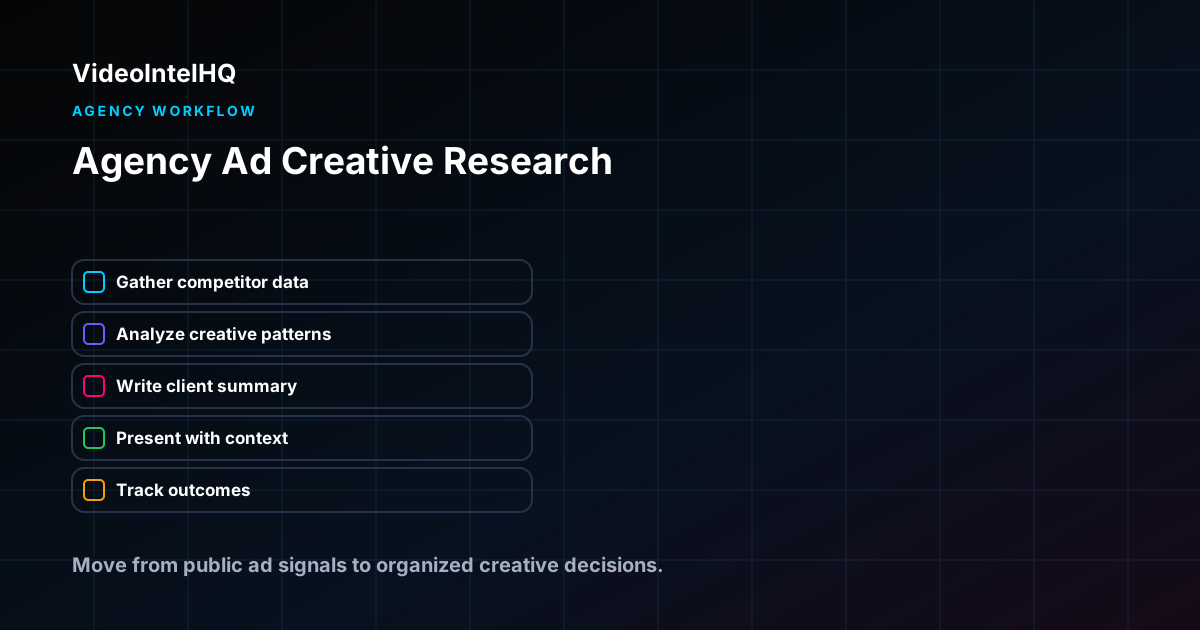
The credibility of an agency competitive report depends on how clearly it separates observation from interpretation. Clients who receive reports that claim competitor ads are "working" based on visible creative activity will eventually ask how you know that — and the answer (you do not have access to their private performance data) creates a trust problem.
The disciplined approach: always write what is observable first, then write what it might mean as a clearly labeled interpretation. "Competitor A has released twelve new creatives using this hook pattern in six weeks (observable). This level of creative output suggests they are actively testing this angle at meaningful budget (interpretation, not confirmed)."
- →Say "observed" or "visible" before describing any competitor creative signal
- →Say "suggests" or "may indicate" before any interpretation of why a signal exists
- →Never say "winning" or "performing well" without a qualifying note that private performance data is not available
- →Be specific about what research covered — what period, what competitors, what platforms
Multi-Client Agency Reporting Cadence
- →Weekly: new competitor creative summaries per client, organized by brand and hook/offer changes
- →Monthly: pattern analysis across the full client competitor set, format and offer trend review, brief recommendations
- →Quarterly: competitive landscape overview, category creative shifts, positioning review for client's own creative direction
- →Separate workspaces per client prevent cross-client data confusion and support clean export per account
- →Automate the monitoring layer so the weekly review is about annotation and insight, not manual data collection
Agency workflow
Agency Review Workflow
Agency teams need a repeatable way to turn competitor activity into client-ready context without promising outcomes from research alone.
Examples by role
How teams use this workflow
Performance marketing agencies
Use agency ad creative research workflow to prepare client-ready weekly notes: what changed, what matters, and which original brief or review action should happen next.
DTC brands
Use agency ad creative research workflow to compare public creative signals against your own product, offer, landing page, and customer research before deciding what to test.
Creative teams
Use agency ad creative research workflow to turn scattered screenshots into structured hook, offer, proof, format, and landing-page notes that can become original briefs.
Media buyers
Use agency ad creative research workflow as planning context before budget and testing conversations, while avoiding unsupported claims about private ROAS, revenue, or conversions.
Related Wade Digital tools
Adjacent workflows to review
These are related Wade Digital tools only where they naturally support the workflow. VideoIntelHQ remains focused on competitor video ad intelligence.
Key Takeaways
- →Agency Ad Creative Research Workflow works best as a repeatable research workflow, not a one-time screenshot collection exercise.
- →Keep public ad observations separate from assumptions about private performance, revenue, ROAS, or account data.
- →Use the research to organize hooks, offers, formats, landing page notes, and next-step creative hypotheses.
Who This Is For
- ✓Performance marketing agencies managing paid social for multiple clients
- ✓Agency creative directors who want to systematize competitive research
- ✓Account managers looking for a structured way to add competitive intelligence to their service
- ✓Paid social consultants building a repeatable research process
- ✓Agency founders building scalable research operations
Build from the research
Use the Operating System after you find the signal.
This guide helps you understand what to look for. The Vertical Video Growth Operating System gives you the AI skills, templates, modes, and workflows to turn that research into finished short-form videos.
Frequently Asked Questions
How long does the weekly review take per client?
Twenty minutes per client once the system is set up. Across a five-client roster, that is under two hours of research time per week.
Can this workflow be delegated to a junior team member?
Yes. Collection, tagging, and basic report assembly can be delegated. Pattern synthesis and hypothesis formation benefit from someone with creative strategy experience.
How do I scale this workflow as the client roster grows?
VideoIntelHQ monitoring scales across multiple client accounts. The synthesis and reporting steps scale with team size. Consider a dedicated research analyst role for large rosters.
What makes competitive research a client-facing differentiator?
Presenting a monthly competitive intelligence report shows clients that your creative decisions are grounded in market evidence. That builds trust and justifies your fee.
How many competitor changes should go into a weekly client report?
Three to seven meaningful competitor observations per week is a practical range. More than seven turns the report into a data dump. Fewer than three suggests the monitoring is too narrow or the review cadence is too infrequent. Prioritize quality of observation over volume of listed ads.
How should I present competitive research limitations to clients honestly?
Proactively include a one-sentence note in every report that visible competitor ad activity reflects public creative signals, not verified private performance data. Clients who understand this framing are more likely to trust the agency's interpretations because they know the agency is not overstating its access or making unsupported claims.
Can agencies use VideoIntelHQ to manage research across multiple client accounts simultaneously?
Yes. VideoIntelHQ supports separate competitor watchlists, creative libraries, and weekly summaries per client account. This is one of the core reasons agencies choose structured monitoring tools over manual research: separate client workspaces with automated monitoring cover more competitors more consistently than any manual research workflow.
Conclusion
Agency Ad Creative Research Workflow is most useful when the research is specific, documented, and connected to a clear next step. Use competitor ad tracking as planning input: monitor public signals, organize creative patterns, and turn the review into briefs or reports your team can act on without overclaiming what the data proves.
Run this workflow with VideoIntelHQ.
Automated competitor monitoring for every client account. One dashboard, consistent research, monthly intelligence reports that drive creative decisions.