AI Creative Strategy Brief Generator
Turn competitor ad research into creative briefs your team can produce
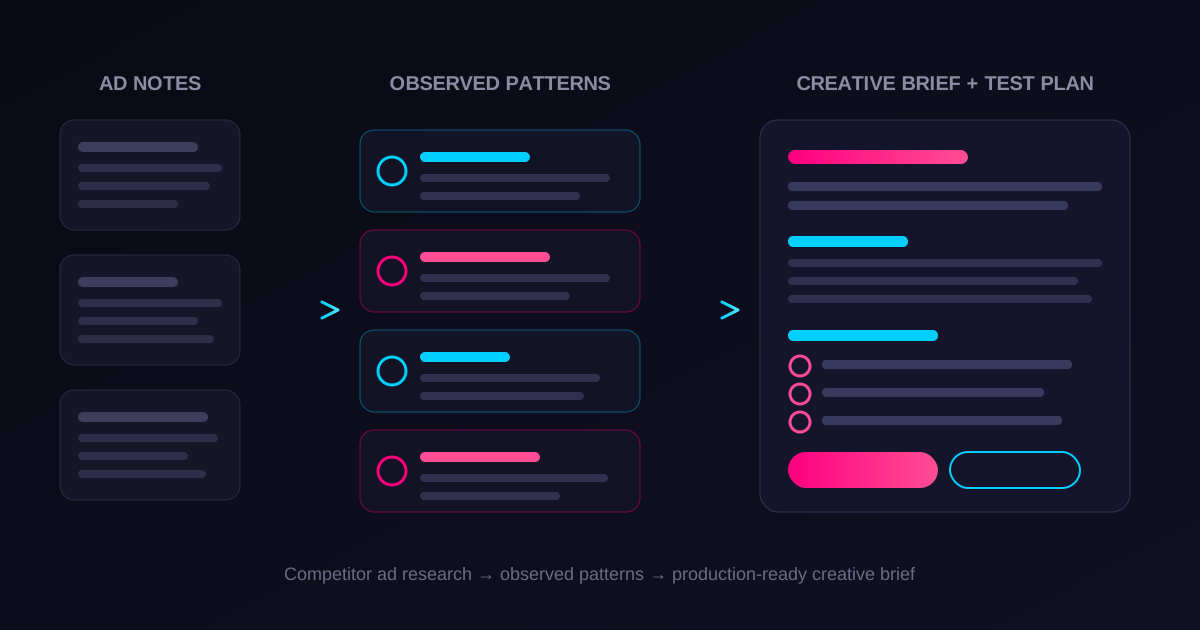
Enter a competitor, landing page, ad library link, or campaign notes. VideoIntelHQ turns observed ad patterns into hook ideas, offer angles, video concepts, and a production-ready creative brief.
Creative briefs are strategy drafts. VideoIntelHQ uses observed patterns and user-provided notes; it does not claim competitor performance unless verified data is provided.
Generate your creative strategy brief
Add a competitor or brand name, a landing page URL, or paste ad notes — at least one is required. The more observations you paste, the more specific the detected patterns.
Who it’s for
Performance marketing agencies
Turn client competitor research into deliverable briefs and test plans without burning strategist hours.
Paid social media buyers
Stop recycling tired creative — brief new angles from the patterns you already see in ad libraries.
DTC brand owners
Get agency-style creative strategy from your own competitor observations, without hiring a strategy team.
Creative strategists
Skip the blank page: start from a structured draft and spend your time sharpening angles.
UGC agencies & creators
Receive briefs with talking points, shot lists, and disclosure notes instead of vague instructions.
Video editors
Get pacing, captions, cuts, and platform specs in a dedicated handoff instead of a Slack thread.
What the brief includes
Creative Snapshot
Competitor, platform, goal, product, audience, and offer context in one card — with an honest note on where the data came from.
Observed Pattern Summary
Hook styles, repeated offers, pain points, benefit claims, visual formats, and CTA styles detected in your notes.
Hook Bank — 10 test ideas
Original problem, curiosity, proof, objection, comparison, urgency, founder, and demo hooks. No competitor wording.
Offer Angle Map
Five message angles — pain relief, outcome, speed, risk-reduction, comparison — each with a CTA suggestion and what to test.
5 Complete Ad Concepts
Hook, 15–30 second script, scene-by-scene outline, overlays, CTA, landing page match, success metric, and risks for each.
UGC Creator Handoff
Creator brief, talking points, shot list, B-roll list, do/don't notes, and disclosure reminders — ready to send.
Editor Handoff
Pacing, first-3-seconds direction, cuts, captions, aspect ratios, platform specs, and thumbnail guidance.
Weekly Creative Test Plan
Priority order, the variable each concept tests, metrics to watch, and what to do when a test fails or works.
Why ad research alone isn’t enough
Anyone can open Meta Ad Library or TikTok Creative Center and scroll competitor ads. The hard part is what happens next: turning a folder of screenshots and half-remembered observations into a brief a creator can film, an editor can cut, and a media buyer can test.
Most competitor research dies in a swipe file. Observations never become hypotheses, hypotheses never become scripts, and the team ends up re-testing the same three ad formats. VideoIntelHQ closes that gap: it takes what you observed, names the patterns, and converts them into original hooks, offer angles, complete ad concepts, and a prioritized weekly test plan — with the production handoffs already written.
The output is deliberately labeled as hypotheses, not winners. No tool can tell you a concept will perform before you test it — but a structured brief means every test teaches you something specific.
Example creative brief preview
Creative Snapshot
Brand researched
Nimbus Kettle Co. (fictional)
Platform
TikTok
Goal
Launch new ad concepts
Product
Gooseneck pour-over kettle
Audience
Home coffee enthusiasts
Source
Sample data
Observed Patterns (sample)
- • Based on the sample notes: problem-first hooks about bitter, inconsistent home coffee.
- • Based on the sample notes: repeated bundle offer (kettle + scale) with seasonal framing.
- • Based on the sample notes: creator-style pour demos filmed on kitchen counters.
Hook Bank (3 of 10)
- • [Problem] “Your coffee isn’t bad because of the beans — it’s your pour.”
- • [Demo] “Watch what a controlled pour actually does to the same beans — no cuts.”
- • [Objection] “I thought a kettle upgrade was pointless. Here’s what I noticed in week one.”
Ad Concepts (2 of 5)
The Morning Pour Fix
Pain-first UGC: creator names the inconsistent-brew frustration, shows one controlled pour, ends with a taste reaction. Tests pain-point resonance. Metric: hook rate.
Side-by-Side Pour Demo
Real-time demo: same beans, standard kettle vs. gooseneck pour, no voiceover. Tests whether raw product proof beats narrative. Metric: CTR.
UGC Handoff (preview)
Talking points: your worst home-brew moment; first pour with the kettle; the one thing that got easier. Shot list: talking head ×2, pour close-up, taste reaction. Include #ad disclosure.
Weekly Test Plan (preview)
Week 1: launch concepts 1–2 (pain hook vs. raw demo). Watch hook rate and CTR. If the pain hook underperforms, swap the opening line before abandoning the angle.
How to use it with UGC creators and editors
For UGC creators
Copy the UGC handoff and send it as-is. Creators get a plain-language brief, specific talking points, a shot list, a B-roll list, and do/don’t notes — including disclosure requirements — so you get usable raw footage on the first round instead of three revision cycles.
For video editors
Copy the editor handoff for pacing targets, first-3-seconds direction, cut guidance, caption and overlay lists, aspect-ratio specs, and thumbnail suggestions. Editors can build multiple hook variations from the same footage without guessing what the strategist intended.
The weekly creative testing workflow
Monday — Review
Scan competitor ads in the public ad libraries. Note hooks, offers, formats, and anything that changed since last week.
Tuesday — Brief
Paste your notes into the generator. Review the observed patterns, pick the strongest angles, and finalize 3–5 concepts.
Wednesday — Handoff
Send the UGC handoff to creators and the editor handoff to your editor. One copy button each.
Thursday–Friday — Produce
Creators film against the shot list; the editor assembles 2–3 hook variations per concept.
Following week — Test & log
Launch on the priority order in the test plan. Log hook rate, hold rate, CTR, and CPA against each hypothesis, then feed what you learned into next Monday's review.
Use it responsibly
- • Use competitor research as inspiration, not copying — never reuse competitor wording, logos, or creative assets.
- • Review every brief before production and verify any claim before putting it in an ad.
- • Follow the ad policies of each platform you publish on.
- • Add disclosures for creators and testimonials where required.
- • VideoIntelHQ does not guarantee ad performance — every concept is a test hypothesis.
- • VideoIntelHQ does not claim competitor spend, ROAS, CPA, or conversion data unless you provide verified data.
Frequently asked questions
What is a creative strategy brief?
A creative strategy brief is a working document that turns research into production direction: which hooks to test, which offer angles to try, what each ad concept should look like, and how creators and editors should execute it. VideoIntelHQ generates a draft brief from your inputs so your team starts from structure instead of a blank page.
Can VideoIntelHQ analyze competitor ads?
VideoIntelHQ analyzes the competitor ad notes, observations, transcripts, and context you provide — for example what you see in Meta Ad Library or TikTok Creative Center. It detects observed patterns like hook styles, offer framing, urgency, social proof, and creative formats, and turns them into original test ideas. It does not scrape platforms or download protected ad assets.
Does this show competitor ad spend or ROAS?
No. VideoIntelHQ does not claim competitor spend, ROAS, CTR, CPA, or conversion data — that information is private, and any tool claiming it without verified data is guessing. Briefs are based on observed patterns and your own notes, and every output is labeled as a test hypothesis rather than a proven winner.
Can it generate UGC scripts?
Yes. Every brief includes a UGC creator handoff: a creator brief, talking points, a shot list, a B-roll list, do/don't notes, product demo moments, authenticity guidance, and required disclosure reminders — ready to paste into a message to your creator.
Can it create ad concepts for TikTok, Meta, or YouTube?
Yes. Choose Meta, TikTok, YouTube Shorts, Instagram Reels, LinkedIn, or Other, and the concepts, pacing notes, and aspect-ratio guidance adjust to the platform. Each brief includes five complete ad concepts with hooks, scripts, scene outlines, and CTAs.
Does it copy competitor ads?
No. Competitor research is used as inspiration for original angles, not for copying. Generated hooks and scripts are new directions built from pattern categories — never competitor wording — and every brief includes compliance notes reminding your team not to reuse competitor copy, logos, or creative assets.
Can I use this with my video editor?
Yes. Each brief includes a dedicated editor handoff with pacing notes, first-3-seconds direction, cut guidance, caption and overlay lists, aspect-ratio and platform notes, and thumbnail suggestions. There is a one-click copy button for the editor handoff alone.
What should I test first?
Every brief ends with a weekly creative test plan that puts the five concepts in priority order and names the single variable each one tests — usually starting with pain-point resonance, then product proof, then objection handling. Watch hook rate, hold rate, CTR, CPC, CPA, and conversion rate to judge each test.
Keep going
Turn this week’s competitor research into next week’s tests
Generate a brief now, then track competitors, save briefs, and build your weekly ad test plan from one dashboard.