Comparison guide
VideoIntelHQ vs Manual Screenshot Folders
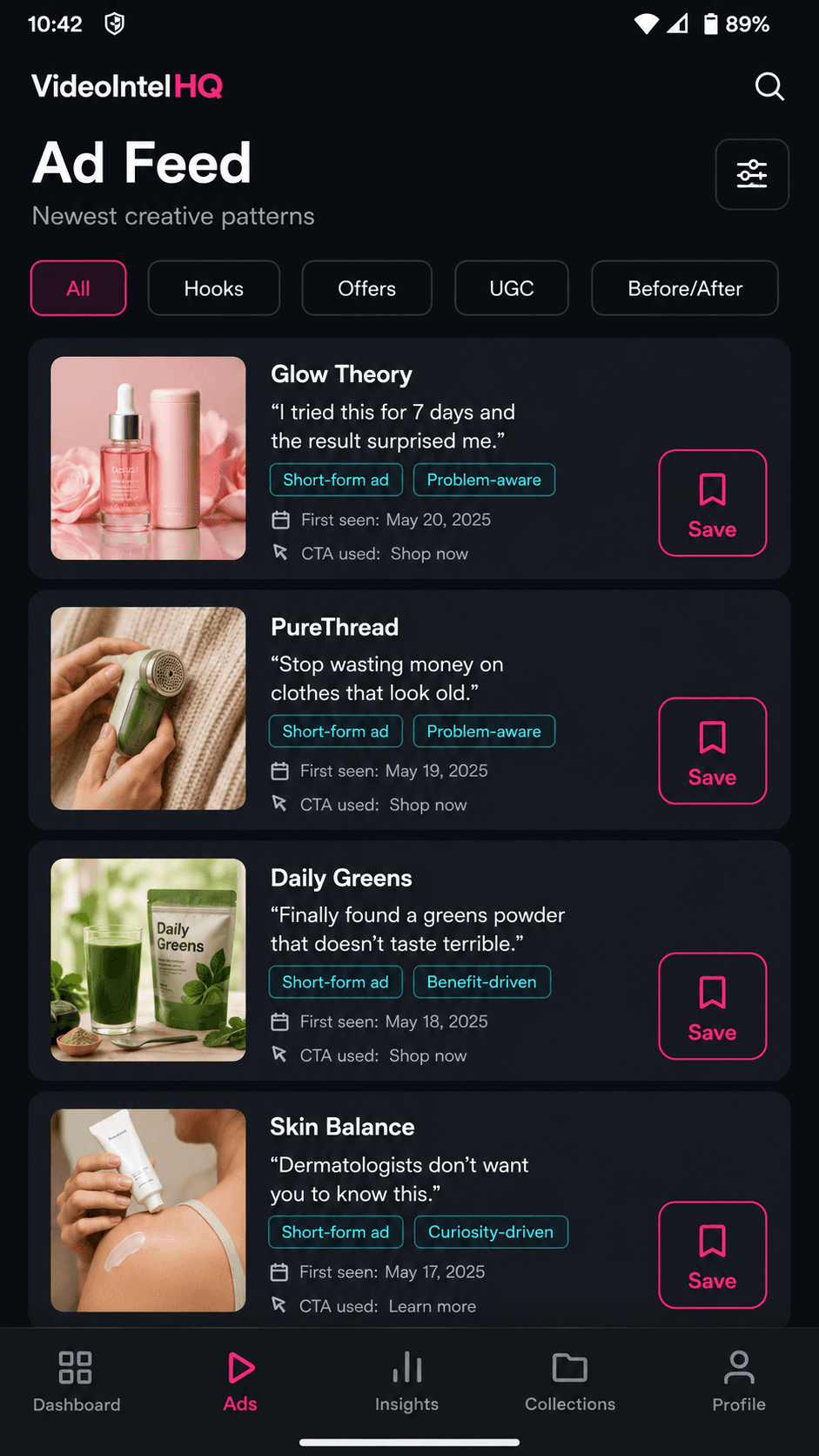
Many teams start competitor ad research with manual screenshot folders. That can be useful early on, but the workflow often breaks down when the team needs consistent watchlists, hook notes, offer tracking, weekly summaries, and client-ready context.
Direct answer
What is competitor video ad tracking?
Competitor video ad tracking is the process of monitoring publicly visible competitor video ads, recording hooks, offers, formats, CTAs, landing page context, and review dates, then using those notes to guide original creative planning without claiming private performance data.
Evaluation criteria
A fair comparison should consider setup speed, consistency, source context, review cadence, collaboration, exportability, and claim quality. The right option depends on how often your team reviews competitor creative and how many people need to use the findings.
- Can the workflow preserve source context and dates?
- Can the team search by hook, offer, format, and competitor?
- Can research be summarized for clients or internal planning?
- Does the workflow avoid unsupported performance claims?
Choose manual screenshot folders if
Choose manual screenshot folders if you only need visual inspiration and do not need source context, review dates, searchable notes, or team decisions.
Choose VideoIntelHQ if
Choose VideoIntelHQ if screenshots are piling up without context and your team needs searchable research records, hook notes, offer notes, and weekly summaries.
Bottom line
Use manual screenshot folders when the workflow is occasional, small, and handled by one person. Use VideoIntelHQ when competitor ad monitoring becomes a recurring operating process that needs structured records, public-signal caveats, and shared weekly decisions.
Pros and cons to review
Examples by team type
Agencies
Use videointelhq vs manual screenshot folders to prepare client-ready weekly notes that explain what changed, why it might matter, and what the next review or brief should cover.
DTC brands
Use videointelhq vs manual screenshot folders to compare public creative signals against your own product, offer, landing page, and customer research before deciding what to test.
Creative strategists
Use videointelhq vs manual screenshot folders to turn scattered inspiration into organized hook, offer, proof, format, and destination-page notes for original briefs.
Media buyers
Use videointelhq vs manual screenshot folders as context before creative testing and budget discussions, while avoiding unsupported claims about private ROAS, revenue, conversions, or campaign outcomes.
Build from the research
Turn this research into a short-form video workflow.
Use this guide to understand the signal, then use the Vertical Video Growth Operating System to create hooks, scripts, publishing plans, reviews, and next actions with AI.
Common mistakes to avoid
Assuming a dedicated tool replaces strategy or customer research
Treating a generic file as reliable when nobody maintains it
Using public examples to make private performance claims
FAQ
Is manual screenshot folders enough for competitor ad research?
It can be enough for small or occasional research. Teams usually need a dedicated workflow when research becomes weekly, multi-brand, or client-facing.
Does VideoIntelHQ rank competitor ads by private performance?
No. VideoIntelHQ is positioned around public creative signals, organized research records, and careful weekly summaries.
Related resources
Move beyond scattered ad research.
Use VideoIntelHQ when your team needs competitor monitoring, hook tracking, offer notes, and weekly summaries in one place.
VideoIntelHQ helps organize public creative research signals. It does not guarantee ad performance, revenue, ROAS, conversions, sales, or campaign outcomes.