Best TikTok Ad Spy Tools for Agencies: What to Evaluate and Why Workflow Fit Matters
Agencies evaluating TikTok ad spy tools have different requirements than individual researchers or in-house brand teams. An agency needs a tool that supports multiple client accounts simultaneously, generates structured weekly deliverables, and helps account managers turn competitive research into presentations and briefs without rebuilding everything from scratch every week.
This guide covers what agencies should evaluate in a TikTok ad spy tool, what workflow requirements matter most, the difference between database-style tools and competitor-monitoring tools, and how to think about responsible research that protects your agency's credibility with clients.
Direct answers
Quick answers for this topic
What is competitor video ad tracking?
Competitor video ad tracking is the process of monitoring publicly visible competitor video ads, recording hooks, offers, formats, CTAs, landing page context, and review dates, then using those notes to guide original creative planning without claiming private performance data.
What is the best way to organize ad research?
The best way to organize ad research is to use a consistent workflow: define the competitor set, capture public creative signals, tag each hook and offer, add landing page notes, choose a next action, and summarize meaningful changes every week.
Related workflow links
Continue the research workflow
Why Agency Requirements Are Different
An individual researcher using a TikTok ad spy tool needs to find relevant ads quickly and save the most interesting ones. An agency running competitor research for multiple clients has a more complex set of requirements.
First, scope: an agency typically manages five to twenty or more client accounts simultaneously, each with its own competitive landscape, creative strategy, and reporting cadence. A tool that works well for monitoring one brand's competitor set needs to scale to handle many separate watchlists without creating confusion.
Second, deliverables: agencies need structured outputs. Competitive intelligence that lives inside a tool but cannot be exported into client presentations or weekly reports creates a workflow dead end. The tool should support the client deliverable format, not require rebuilding the output from scratch.
Third, team access: multiple people on the agency team touch a given account. Account managers, media buyers, creative strategists, and analysts each need different things from the competitive research. A tool that only works for a single analyst does not scale to agency team workflows.
The Key Requirements for Agency TikTok Ad Tools
Multi-client watchlist management
The tool must support separate, independent competitor sets for each client account. Mixing competitor data across client accounts creates confusion and potential conflicts of interest. Each client should have their own watchlist with their own creative library, hook pattern notes, and offer tracking.
Automated monitoring with weekly outputs
Manually checking competitor creative for five or ten client accounts every week is not sustainable. The best tools run monitoring automatically and generate weekly summaries of new creatives, hook changes, and offer shifts — one per client account — so account managers start the week with organized intelligence rather than a stack of manual work.
Structured tagging and categorization
Raw creative discovery is not enough. The tool should support consistent tagging of hooks by pattern type, creative format labels, offer and CTA notes, and landing page observations. Consistent tagging turns individual observations into a searchable pattern library — which is what makes the intelligence library useful for briefing and reporting.
Export and report generation
The competitive intelligence library needs to flow into client deliverables. Look for tools that support export formats compatible with your reporting workflow: structured data exports, creative matrix exports, weekly summary exports, and brief-ready outputs. Tools that trap research inside a proprietary interface without export options create bottlenecks in the agency workflow.
Longitudinal history
Point-in-time discovery is less useful than longitudinal monitoring. Agencies that can show a client how a competitor's creative strategy has evolved over three months are providing higher-value intelligence than agencies that can only say "here is what they are running right now." The tool should maintain a searchable history of everything monitored.
Types of TikTok Ad Tools: How They Compare for Agencies
There are three main types of tools agencies consider for TikTok competitive research, each with different strengths and weaknesses for agency workflows.
Broad ad database tools
Database tools maintain large inventories of ads from many brands and allow search and filter across the database. Strengths: wide exposure, useful for discovery and inspiration. Weaknesses for agencies: not designed for specific competitor monitoring, no longitudinal tracking of specific brands, limited multi-client workflow structure, performance scores based on unknown or unverifiable metrics.
Specific competitor monitoring tools
Monitoring tools track specific competitor brands continuously, alert teams to new creative, and build longitudinal libraries. Strengths: systematic coverage of the competitor set that matters for each client, longitudinal hook and offer tracking, multi-client workflow support. Weaknesses: smaller initial ad inventory for discovery vs. broad databases.
Manual research with organization tools
Some agencies combine manual creative research with organization tools like Notion or Airtable. Strengths: flexible structure, no tool cost. Weaknesses: no automated monitoring, no alerts, no hook categorization built in, significant manual effort to maintain, difficult to scale across more than a few clients.
Evaluating Specific Tool Claims
Agencies should be cautious about specific claims made by TikTok ad spy tools. These are the claims worth scrutinizing most carefully.
- →Performance scores: claims that certain ads have specific ROAS, revenue, or conversion rates from public data — these cannot be verified and are typically speculative
- →Spend data: claims about competitor spend amounts from public creative observation — private platform spend data is not publicly available
- →Winning ad identification: claims to identify "winning" ads from public visibility alone — winning requires private performance context
- →Platform approval advantages: claims that using the tool gives ads better platform approval rates — there is no public evidence this is possible
- →Private account access: claims to access private TikTok ad account data — legitimate tools work only with public creative
The Agency Creative Intelligence Workflow with VideoIntelHQ
Week 1: Client setup
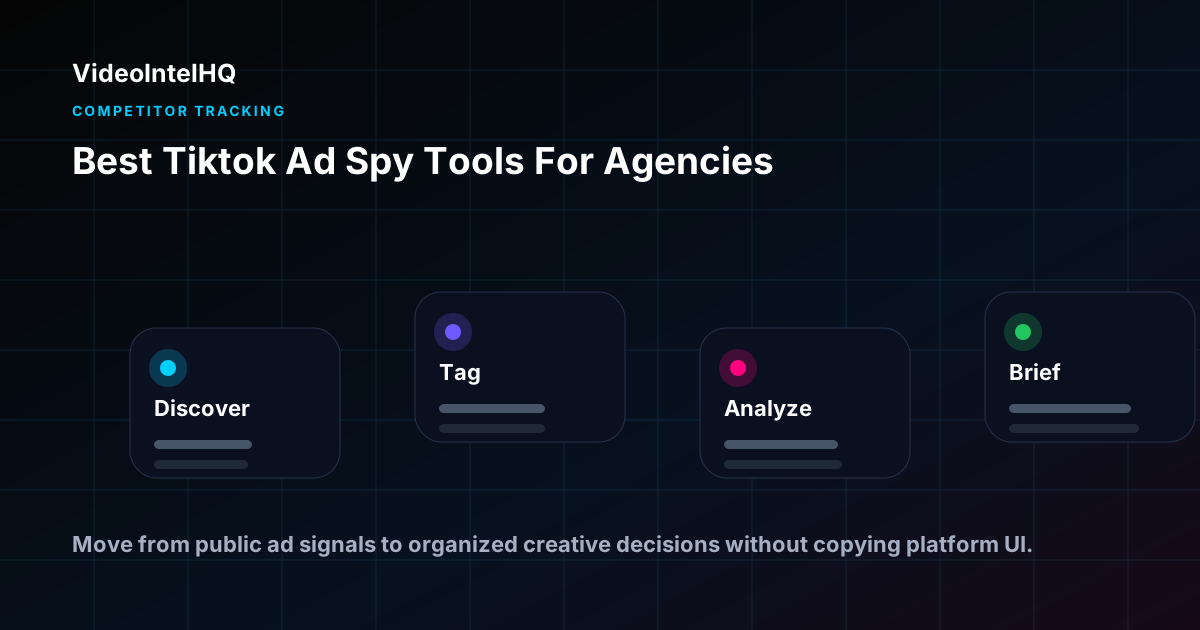
Create a competitor watchlist for each client account. Add direct competitors, adjacent brands, and one or two aspirational creative references. Define the hook categories and offer tracking relevant to each client's vertical.
Ongoing: Automated monitoring
VideoIntelHQ monitors public competitor creative for all client accounts simultaneously. New creatives, hook changes, and offer shifts are captured automatically. Account managers do not need to check manually between weekly reviews.
Weekly: Review and annotate
Review the weekly summary for each client account. Add notes on the most relevant observations. Flag hooks worth briefing, offers worth reporting, and format changes worth watching. This review typically takes 15–30 minutes per client.
Weekly: Client deliverable
Export the organized weekly intelligence for each client. Present new creatives, hook pattern shifts, and offer changes in the client-facing format your agency uses — presentation slides, email update, or shared document.
Monthly: Pattern analysis
Run a monthly review across all client accounts to identify larger trends: which categories are shifting creative formats, which clients' competitors are escalating offer structures, which hook angles are emerging. Monthly pattern analysis informs quarterly creative strategy discussions.
What Agencies Report After Using VideoIntelHQ
Agencies that implement VideoIntelHQ as their TikTok competitor intelligence tool typically report a few consistent workflow improvements: the time spent on manual competitor checking per week drops significantly because automated monitoring replaces manual scrolling. Weekly client competitive intelligence becomes a structured deliverable rather than an ad hoc screenshot dump. Creative briefs become better-grounded in market reality because they start from organized patterns rather than whatever was seen most recently.
These are workflow improvements, not performance guarantees. The competitive intelligence provides better planning context; the actual creative performance depends on the offer, audience, creative execution, landing page, and many other factors outside the competitive research workflow.
How to Choose the Right Tool for Your Agency
- →Start with multi-client workflow: does the tool support separate watchlists and outputs per client?
- →Check monitoring vs. database: does the tool do specific competitor monitoring or broad database search?
- →Evaluate export options: can you get structured creative matrices and weekly summaries in formats that work for client delivery?
- →Test longitudinal tracking: does the tool maintain history so you can show how a competitor's strategy has evolved?
- →Assess claim quality: does the tool make responsible, verifiable claims or promise private data and guaranteed performance insights?
- →Consider team access: can multiple team members (account managers, media buyers, creative strategists) use the tool in the same account?
How VideoIntelHQ Supports Agency Workflows
VideoIntelHQ is built with agency multi-client workflow in mind. Separate competitor watchlists and research libraries per client, automated weekly summaries, hook pattern and offer tracking with consistent tagging, and export-ready intelligence outputs. For more detail on agency-specific features and pricing, visit the agency use cases page, features page, or contact the team to discuss your specific client research needs.
Agency workflow
Agency Review Workflow
Agency teams need a repeatable way to turn competitor activity into client-ready context without promising outcomes from research alone.
Examples by role
How teams use this workflow
Performance marketing agencies
Use best tiktok ad spy tools for agencies: what to evaluate and why workflow fit matters to prepare client-ready weekly notes: what changed, what matters, and which original brief or review action should happen next.
DTC brands
Use best tiktok ad spy tools for agencies: what to evaluate and why workflow fit matters to compare public creative signals against your own product, offer, landing page, and customer research before deciding what to test.
Creative teams
Use best tiktok ad spy tools for agencies: what to evaluate and why workflow fit matters to turn scattered screenshots into structured hook, offer, proof, format, and landing-page notes that can become original briefs.
Media buyers
Use best tiktok ad spy tools for agencies: what to evaluate and why workflow fit matters as planning context before budget and testing conversations, while avoiding unsupported claims about private ROAS, revenue, or conversions.
Related Wade Digital tools
Adjacent workflows to review
These are related Wade Digital tools only where they naturally support the workflow. VideoIntelHQ remains focused on competitor video ad intelligence.
Key Takeaways
- →Best TikTok Ad Spy Tools for Agencies: What to Evaluate and Why Workflow Fit Matters works best as a repeatable research workflow, not a one-time screenshot collection exercise.
- →Keep public ad observations separate from assumptions about private performance, revenue, ROAS, or account data.
- →Use the research to organize hooks, offers, formats, landing page notes, and next-step creative hypotheses.
Who This Is For
- ✓Performance marketing agency leaders evaluating tools for scaled competitor research
- ✓Account managers responsible for competitive intelligence across multiple client accounts
- ✓Media buyers at agencies who need structured creative context for testing decisions
- ✓Creative strategists building hook libraries and brief inputs for agency clients
- ✓Agency operations teams looking to reduce manual research time and improve deliverable quality
Build from the research
Use the Operating System after you find the signal.
This guide helps you understand what to look for. The Vertical Video Growth Operating System gives you the AI skills, templates, modes, and workflows to turn that research into finished short-form videos.
Frequently Asked Questions
What should agencies prioritize when evaluating TikTok ad spy tools?
Multi-client watchlist support, automated monitoring with weekly summaries, structured tagging for hooks and offers, export-ready formats for client deliverables, and longitudinal tracking that shows how competitor creative evolves over time. Performance claims and private data promises are red flags, not selling points.
How many competitors should an agency track per client?
Five to ten direct competitors per client is a practical range. More than ten becomes difficult to review consistently every week. Including adjacent brands and one or two aspirational creative references alongside direct competitors gives a wider view of category creative patterns without creating an unmanageable watchlist.
Can junior team members use VideoIntelHQ for agency research?
Yes. Junior analysts can review and tag new competitive creative in VideoIntelHQ. Senior account managers and media buyers review the organized weekly summaries and make strategic recommendations. The structured workflow scales across experience levels because the tagging and summarization happens inside the tool rather than requiring senior oversight of every step.
How does VideoIntelHQ compare to using a spreadsheet for agency competitive research?
Spreadsheets require manual input, have no monitoring capability, do not alert teams to new creative, and become difficult to maintain across more than a few clients. VideoIntelHQ adds automated monitoring, structured tagging, searchable creative history, and export-ready outputs — reducing the manual maintenance burden while improving the organization and completeness of the research.
Is competitive ad research safe to share with clients?
Yes, when done responsibly. Share what is publicly observable — new creative, hook patterns, offer changes — and be clear that public ad visibility does not confirm revenue, ROAS, or private performance. Agencies that qualify their competitive intelligence with appropriate epistemic humility are more credible with sophisticated clients than those making strong claims from limited public data.
Conclusion
Best TikTok Ad Spy Tools for Agencies: What to Evaluate and Why Workflow Fit Matters is most useful when the research is specific, documented, and connected to a clear next step. Use competitor ad tracking as planning input: monitor public signals, organize creative patterns, and turn the review into briefs or reports your team can act on without overclaiming what the data proves.
Build a scalable agency competitive intelligence workflow with VideoIntelHQ.
Manage competitor watchlists across client accounts, get weekly automated summaries, and export structured creative intelligence for client delivery — without the manual research burden.