Offer Testing Research for Paid Social Campaigns
Offer Testing Research for Paid Social Campaigns helps paid social teams planning offer tests turn public competitor ad signals into clearer creative research, better briefs, and more organized testing plans. The goal is not to copy competitor ads or claim guaranteed performance. The goal is to monitor what is visible, identify creative patterns, and plan differentiated tests.
This guide focuses on offer testing research: what to watch, how to organize findings, and how to turn observations into a useful creative strategy workflow. Results depend on offer, audience, creative quality, budget, landing page, tracking, and execution.
Direct answers
Quick answers for this topic
What is competitor video ad tracking?
Competitor video ad tracking is the process of monitoring publicly visible competitor video ads, recording hooks, offers, formats, CTAs, landing page context, and review dates, then using those notes to guide original creative planning without claiming private performance data.
How do you monitor offer changes?
Monitor offer changes by reviewing public ad and landing page messages on a consistent cadence, then logging the offer type, CTA, urgency language, destination-page promise, date observed, and whether the change should be watched, briefed, or reported.
What is the best way to organize ad research?
The best way to organize ad research is to use a consistent workflow: define the competitor set, capture public creative signals, tag each hook and offer, add landing page notes, choose a next action, and summarize meaningful changes every week.
Related workflow links
Continue the research workflow
Why Offer Testing Research for Paid Social Campaigns Matters for Your Team
Offer Testing Research for Paid Social Campaigns addresses a specific gap that many paid social teams encounter: the gap between knowing that competitive research is valuable and actually having a research workflow that produces consistent, actionable intelligence without becoming a time-sink. The teams that get this right treat offer testing research as a repeatable process rather than a one-time project — which is why the structure matters as much as the tool.
When a team starts treating offer testing research as infrastructure rather than an occasional task, several things change. The research becomes more consistent because the workflow has a defined cadence. The intelligence becomes more useful because findings are organized in a searchable structure rather than scattered across screenshots and notes. The briefs improve because they are grounded in pattern-level observations from the research library rather than whatever creative was seen most recently.
This distinction — infrastructure vs. project — is the difference between teams that build genuine competitive intelligence over time and teams that periodically rediscover what their competitors are doing without ever accumulating an organized knowledge base.
A Practical Framework for Getting Started
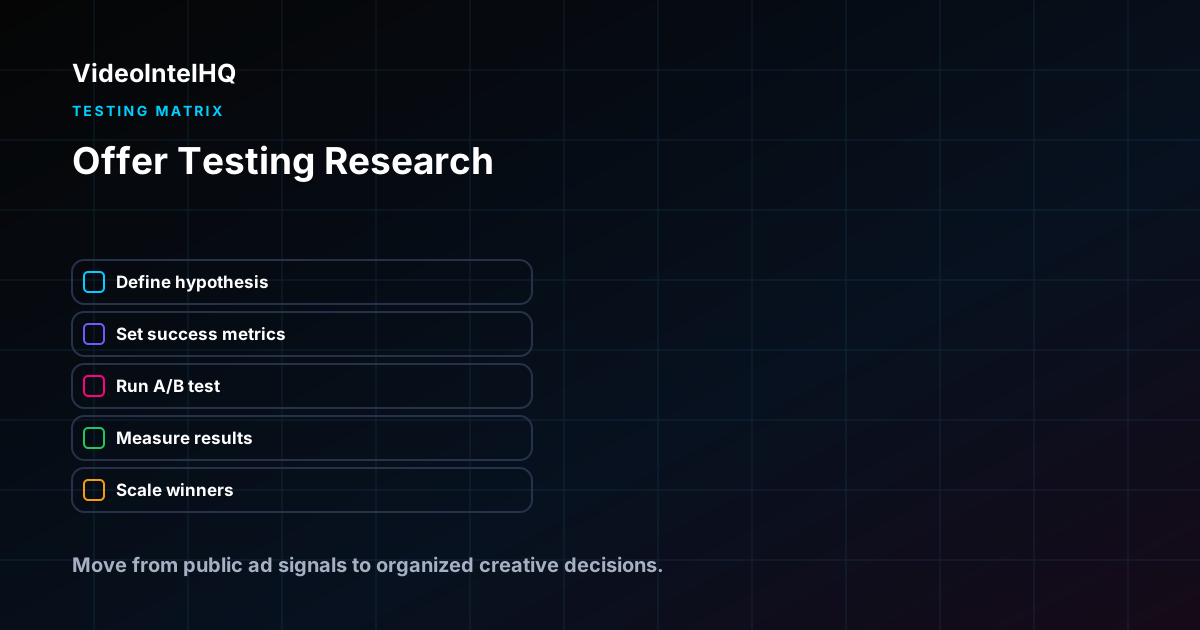
Whether Offer Testing Research for Paid Social Campaigns is new to your team or an existing process that needs better structure, a practical starting framework has five components:
1. Define what you are researching: which competitors, which platforms, which specific signals (hooks, offers, formats, landing pages, or all of the above). A clear scope prevents the research from becoming too broad to review consistently.
2. Set up a monitoring cadence that matches your team's production cycle. Weekly reviews work for active paid social programs. Monthly reviews are better for stable categories or teams with longer creative production timelines.
3. Use consistent classification tags for every entry in your research library. Hook patterns, offer structures, and creative formats should use the same taxonomy across all entries. Consistency is what makes the library searchable for pattern analysis.
4. Connect every observation to a next step: brief a differentiated test, monitor for pattern development, report to stakeholders, or archive as noise. Research without a decision framework grows without producing value.
5. Review the system quarterly: which competitors are still relevant, which classification categories are useful, and whether the output formats still match what the team needs.
- →Start with the specific competitors and signals that matter most for your current brief and testing cycle
- →Use consistent tags for hook patterns, offer structures, and creative formats across all entries
- →Connect each observation to a decision: brief, monitor, report, or archive
- →Review and refine the system quarterly to keep it aligned with team needs
Manual vs. Structured: How Offer Testing Research for Paid Social Campaigns Changes Your Workflow
Most teams start Offer Testing Research for Paid Social Campaigns with a manual process: checking competitor pages, saving screenshots, and discussing findings in meetings or chat threads. This approach works for a one-off review but breaks down when the team needs consistent intelligence across multiple competitors, clients, or review periods.
The manual approach
Manual competitor research typically involves checking three to five competitor profiles or the TikTok Creative Center on a weekly basis, saving interesting ads to a folder or Notion page, and discussing findings in a team meeting or chat thread. The manual approach works for initial discovery but has structural limitations: no automated alerts mean new creative can go unnoticed between manual checks, screenshots lack consistent classification tags needed for pattern analysis, findings are hard to search or compare across review periods, and the research output is often a conversation rather than a structured deliverable.
The structured approach with VideoIntelHQ
A structured approach using VideoIntelHQ replaces manual checking with automated competitor monitoring. New creative is captured as it appears, classified with consistent hook and offer tags, and organized into a searchable library that grows more valuable over time. Weekly summaries consolidate the most important observations for each competitor or client account, and the research library supports longitudinal analysis that manual methods cannot match. The structured approach does not require more time — it requires different time allocation. Instead of spending two hours manually checking competitor profiles, the team spends thirty minutes reviewing organized weekly summaries and tagging new entries into the library. The remaining ninety minutes goes into analysis, brief writing, and strategic discussions rather than data collection.
The Five Components of a Trackable Offer
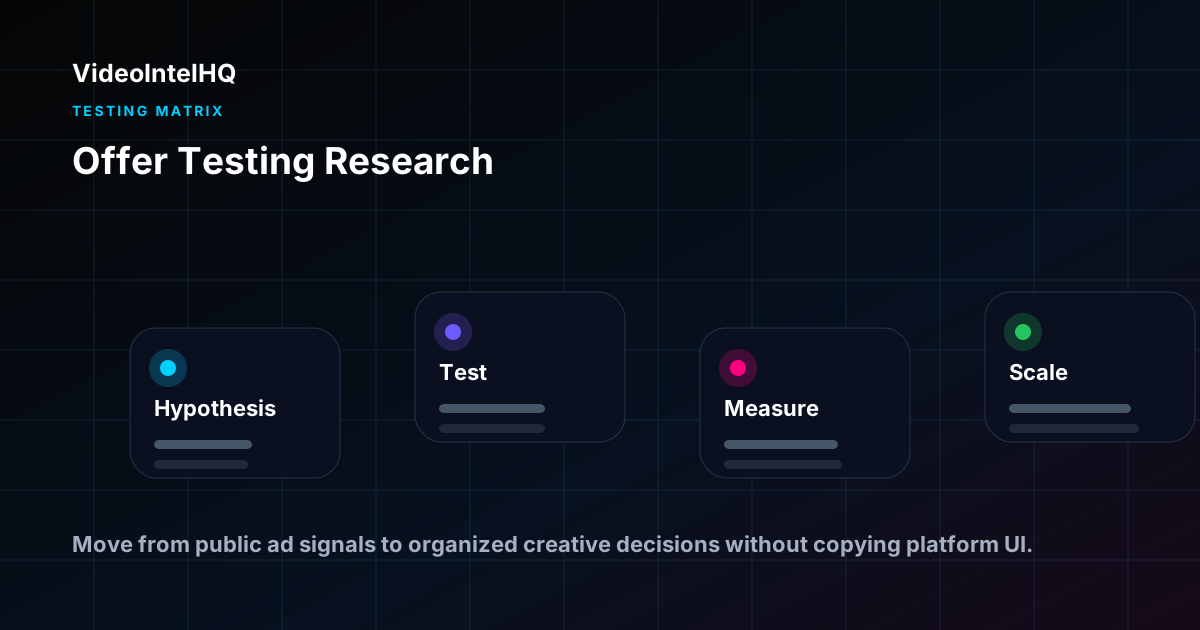
In paid social ads, an offer is not just a discount percentage. Offer testing research for paid social campaigns requires capturing all five components that make up a competitive offer: the headline incentive, the supporting structure, the urgency frame, the risk reversal, and the CTA language. Missing any one of these makes it harder to compare offers across competitors or spot when a meaningful change has occurred.
- →Headline incentive: the primary value statement — discount percentage, dollar off, free item, bundle, or trial
- →Supporting structure: what backs up the headline — what is included, what qualifies, what the conditions are
- →Urgency frame: whether and how time or scarcity pressure is used — today only, limited stock, ends Sunday
- →Risk reversal: the guarantee or safety net offered — money-back, try-before-you-buy, free returns, cancel anytime
- →CTA language: the exact action the ad asks the viewer to take and how it is phrased on the button or end card
Recognizing an Offer Change Signal
Not every variation in a competitor ad constitutes an offer change worth tracking. A useful framework for deciding whether to flag something: has the headline incentive changed, has the offer structure changed, has the urgency frame changed, or has the CTA language changed? If any of these four elements are different from the competitor's previous visible offer, it is worth documenting.
The most significant offer changes to watch for are escalation signals — when a competitor moves from a standard discount to a bundle, from a bundle to a free-trial, or from regular pricing to a time-limited urgent offer. These escalation patterns often signal a competitive response to market pressure or a new testing cycle worth monitoring.
Offer Escalation Patterns: How to Identify Competitive Pressure
Offer escalation is one of the most visible competitive signals in paid social. When a competitor offers a standard 20% discount and then shifts to a buy-one-get-one bundle or a free-trial-plus-shipping structure, the escalation signals something changed in their competitive assessment: either their conversion rates declined on the previous offer structure, or a competitor in the category made an offer move that required a response.
Tracking escalation across multiple competitors reveals the category-level offer dynamics. When three or more competitors escalate offers within the same two-week window, the category is in a competitive pressure cycle. This is valuable intelligence for deciding whether to match the escalation or hold position and differentiate on creative quality and audience targeting rather than price competition.
- →Single offer change: one competitor shifts from discount X to discount Y — watch for response from other competitors
- →Convergent escalation: multiple competitors shift to similar offer structures simultaneously — category pressure cycle
- →Divergent offer strategy: one competitor offers a significantly different structure (e.g., free trial vs. discount) — potential differentiation play
- →Escalation timing: track when in the month or season competitors escalate — recurring patterns reveal strategic timing
From Offer Tracking to Creative Brief: Incorporating Offer Intelligence
The bridge between offer tracking and creative briefs is often underbuilt. Many teams track competitor offers but do not explicitly incorporate offer intelligence into their brief process. A brief that recommends testing a curiosity-gap hook with a 30% discount is more complete than a brief that only addresses the hook direction.
When writing briefs from offer tracking intelligence, include: the current competitive offer baseline in the category, any escalation signals from the past two to four weeks, the recommended offer structure for the test, and a note on landing page alignment — ensuring the ad offer and the page offer match precisely. Briefs that address both creative and commercial structure produce more effective campaigns than briefs that treat the offer as a separate decision.
Seasonal Offer Pattern Analysis
Offer research becomes most strategically useful when you look at patterns over time rather than individual changes. Seasonal offer cycles are visible in competitor ad libraries: certain offer structures appear more frequently during specific periods, disappear, and return in modified form the following year.
Building a seasonal offer map
After three to six months of tracking competitor offers, group the observations by calendar period. Which months show the highest offer escalation activity? Which offer structures appear specifically during promotional seasons? This creates a reference point for timing your own promotional decisions relative to the competitive landscape.
Offer convergence signals
When three or more competitors shift to the same offer structure in the same two to four week window, it is a convergence signal. Convergence can mean the category is responding to consumer demand for a specific offer type, or it can mean competitive escalation where each brand matches the previous brand's offer. Both are worth noting with different strategic implications.
Offer-to-Landing-Page Alignment Research
Offer research is incomplete without checking what the destination page says. The gap between the ad offer and the landing page offer is one of the most common — and most diagnostic — research observations in competitive analysis.
- →When ad and landing page offers match precisely, the competitor is running a tight funnel message
- →When the landing page offer is more generous than the ad offer, the competitor may be testing landing page performance against a controlled ad
- →When the landing page offer is weaker than the ad offer, the competitor may have poor funnel alignment — a strategic opportunity for your brand
- →When the landing page has no clear offer and relies on product browsing, the competitor is likely running traffic to a brand awareness or catalog destination
Ad intelligence workflow
Ad Research Workflow
Use this workflow to move from public competitor ad signals to a practical creative research note your team can review.
Examples by role
How teams use this workflow
Performance marketing agencies
Use offer testing research for paid social campaigns to prepare client-ready weekly notes: what changed, what matters, and which original brief or review action should happen next.
DTC brands
Use offer testing research for paid social campaigns to compare public creative signals against your own product, offer, landing page, and customer research before deciding what to test.
Creative teams
Use offer testing research for paid social campaigns to turn scattered screenshots into structured hook, offer, proof, format, and landing-page notes that can become original briefs.
Media buyers
Use offer testing research for paid social campaigns as planning context before budget and testing conversations, while avoiding unsupported claims about private ROAS, revenue, or conversions.
Related Wade Digital tools
Adjacent workflows to review
These are related Wade Digital tools only where they naturally support the workflow. VideoIntelHQ remains focused on competitor video ad intelligence.
Key Takeaways
- →Offer Testing Research for Paid Social Campaigns works best as a repeatable research workflow, not a one-time screenshot collection exercise.
- →Keep public ad observations separate from assumptions about private performance, revenue, ROAS, or account data.
- →Use the research to organize hooks, offers, formats, landing page notes, and next-step creative hypotheses.
Who This Is For
- ✓Performance marketing agencies creating client research and creative briefs
- ✓DTC and ecommerce brand teams planning paid social tests
- ✓Media buyers looking for better creative context before budget allocation
- ✓Creative strategists organizing hook, offer, and format patterns
- ✓Founders, growth marketers, and freelancers building a repeatable ad research workflow
Build from the research
Use the Operating System after you find the signal.
This guide helps you understand what to look for. The Vertical Video Growth Operating System gives you the AI skills, templates, modes, and workflows to turn that research into finished short-form videos.
Frequently Asked Questions
What is offer testing research for paid social campaigns?
It is a structured way to monitor public competitor ad signals, organize creative patterns, and turn research into briefs or testing ideas for offer testing research.
Does VideoIntelHQ access private ad account data?
No. VideoIntelHQ is designed around public ad signals and organized creative research workflows. It does not provide unauthorized access to private ad data.
Can this research guarantee better ad performance?
No. Research can improve planning quality, but performance depends on offer, audience, creative execution, budget, landing page, tracking, and campaign setup.
How often should teams review competitor ads?
Weekly reviews are useful for active markets. Monthly reviews are better for deeper pattern analysis, reporting, and creative strategy planning.
Should teams copy competitor ads?
No. Use competitor ads to identify patterns and inspire differentiated hypotheses. Copying directly creates brand, legal, and strategic risks.
What counts as an offer change worth tracking?
Any change in the headline incentive, offer structure, urgency frame, risk reversal, or CTA language constitutes an offer change worth documenting. Minor copy tweaks within the same offer structure are lower priority but worth noting in the research log with a brief description of what changed.
How often do competitors typically change their offers?
In most DTC and ecommerce categories, competitors change active offer structures every two to six weeks. Evergreen offers may stay stable for months. Promotional periods can trigger changes weekly. The monitoring cadence should match the category tempo — more frequent during high-activity promotional periods.
Should I track offers that appear to have failed?
Yes, if you can identify them. When a competitor runs an offer briefly and then removes it, that is useful negative signal data. The absence of follow-up on a specific offer structure is as informative as the presence of repeated offers. Track the start date, end date, and return status of competitor offers when possible.
Conclusion
Offer Testing Research for Paid Social Campaigns is most useful when the research is specific, documented, and connected to a clear next step. Use competitor ad tracking as planning input: monitor public signals, organize creative patterns, and turn the review into briefs or reports your team can act on without overclaiming what the data proves.
Turn competitor ad research into better creative planning.
Use VideoIntelHQ to monitor public ad signals, organize hooks and offers, and build research-backed briefs, reports, and testing plans.