Short-Form Video Ad Research: What to Look For and How to Use It
Short-form video ads — fifteen to sixty seconds of vertical video — operate differently from static image or long-form video ads. The hook has to land in the first two to three seconds. The offer has to be clear within fifteen. The CTA has to feel earned, not forced.
Researching short-form video ads requires a framework designed for how these ads actually work. This guide covers what to look for, how to identify patterns across competitor creative, and how to turn your research into actionable testing briefs.
Direct answers
Quick answers for this topic
What is competitor video ad tracking?
Competitor video ad tracking is the process of monitoring publicly visible competitor video ads, recording hooks, offers, formats, CTAs, landing page context, and review dates, then using those notes to guide original creative planning without claiming private performance data.
What is the best way to organize ad research?
The best way to organize ad research is to use a consistent workflow: define the competitor set, capture public creative signals, tag each hook and offer, add landing page notes, choose a next action, and summarize meaningful changes every week.
Related workflow links
Continue the research workflow
Why Short-Form Video Ad Research: What to Look For and How to Use It Matters for Your Team
Short-Form Video Ad Research: What to Look For and How to Use It addresses a specific gap that many use case teams encounter: the gap between knowing that competitive research is valuable and actually having a research workflow that produces consistent, actionable intelligence without becoming a time-sink. The teams that get this right treat short form video ad research as a repeatable process rather than a one-time project — which is why the structure matters as much as the tool.
When a team starts treating short form video ad research as infrastructure rather than an occasional task, several things change. The research becomes more consistent because the workflow has a defined cadence. The intelligence becomes more useful because findings are organized in a searchable structure rather than scattered across screenshots and notes. The briefs improve because they are grounded in pattern-level observations from the research library rather than whatever creative was seen most recently.
This distinction — infrastructure vs. project — is the difference between teams that build genuine competitive intelligence over time and teams that periodically rediscover what their competitors are doing without ever accumulating an organized knowledge base.
A Practical Framework for Getting Started
Whether Short-Form Video Ad Research: What to Look For and How to Use It is new to your team or an existing process that needs better structure, a practical starting framework has five components:
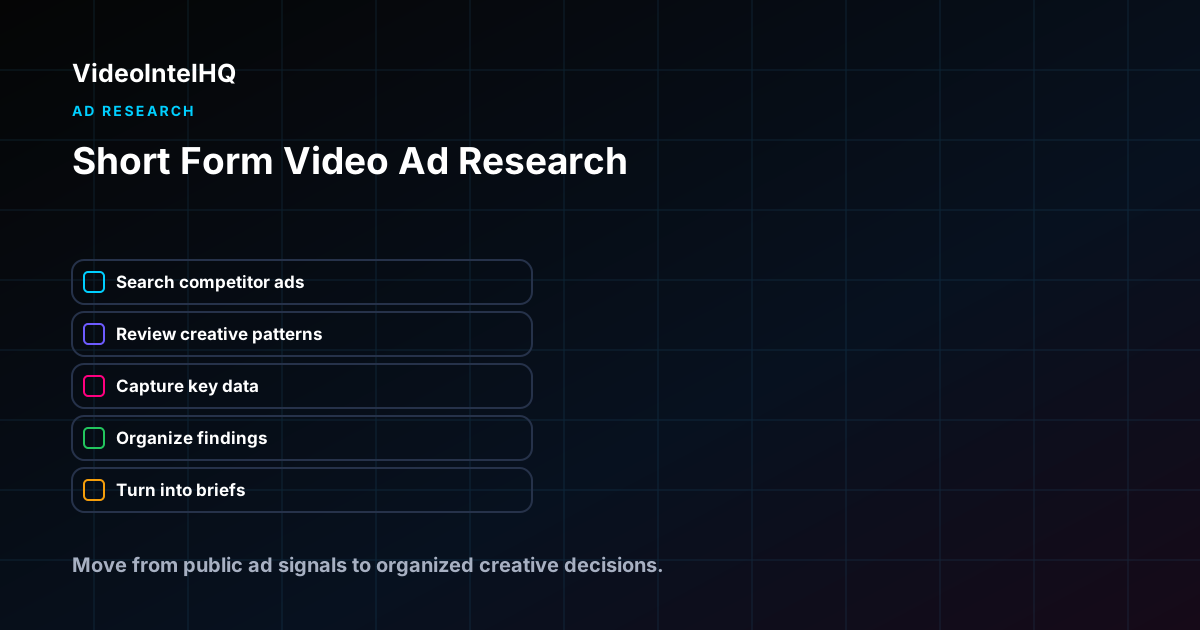
1. Define what you are researching: which competitors, which platforms, which specific signals (hooks, offers, formats, landing pages, or all of the above). A clear scope prevents the research from becoming too broad to review consistently.
2. Set up a monitoring cadence that matches your team's production cycle. Weekly reviews work for active paid social programs. Monthly reviews are better for stable categories or teams with longer creative production timelines.
3. Use consistent classification tags for every entry in your research library. Hook patterns, offer structures, and creative formats should use the same taxonomy across all entries. Consistency is what makes the library searchable for pattern analysis.
4. Connect every observation to a next step: brief a differentiated test, monitor for pattern development, report to stakeholders, or archive as noise. Research without a decision framework grows without producing value.
5. Review the system quarterly: which competitors are still relevant, which classification categories are useful, and whether the output formats still match what the team needs.
- →Start with the specific competitors and signals that matter most for your current brief and testing cycle
- →Use consistent tags for hook patterns, offer structures, and creative formats across all entries
- →Connect each observation to a decision: brief, monitor, report, or archive
- →Review and refine the system quarterly to keep it aligned with team needs
Manual vs. Structured: How Short-Form Video Ad Research: What to Look For and How to Use It Changes Your Workflow
Most teams start Short-Form Video Ad Research: What to Look For and How to Use It with a manual process: checking competitor pages, saving screenshots, and discussing findings in meetings or chat threads. This approach works for a one-off review but breaks down when the team needs consistent intelligence across multiple competitors, clients, or review periods.
The manual approach
Manual competitor research typically involves checking three to five competitor profiles or the TikTok Creative Center on a weekly basis, saving interesting ads to a folder or Notion page, and discussing findings in a team meeting or chat thread. The manual approach works for initial discovery but has structural limitations: no automated alerts mean new creative can go unnoticed between manual checks, screenshots lack consistent classification tags needed for pattern analysis, findings are hard to search or compare across review periods, and the research output is often a conversation rather than a structured deliverable.
The structured approach with VideoIntelHQ
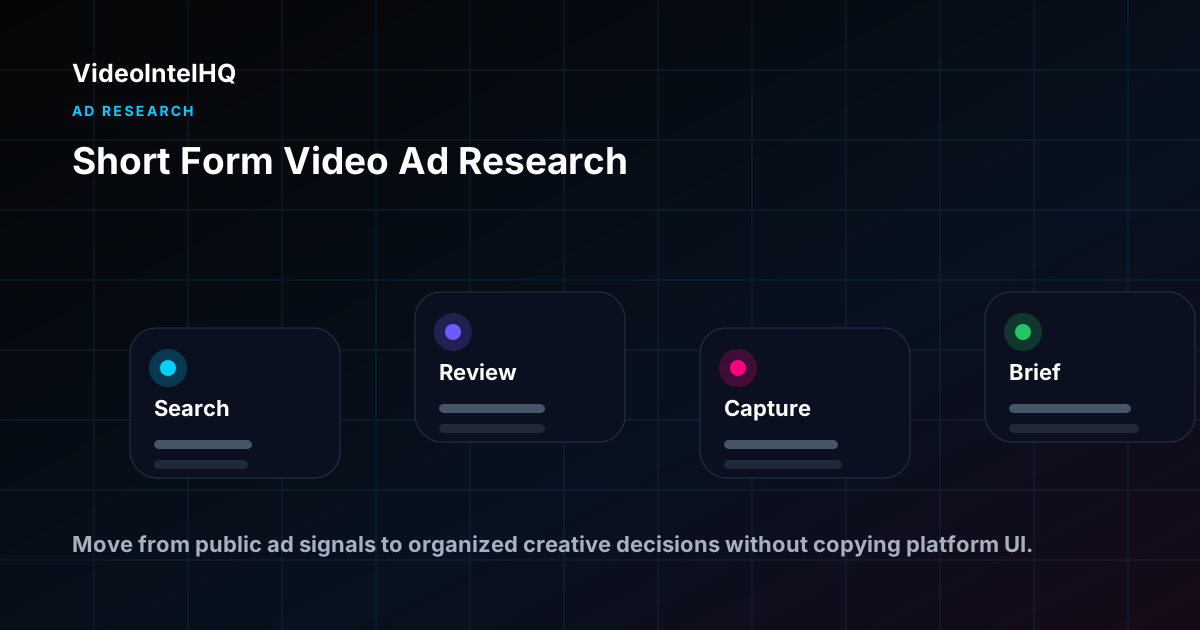
A structured approach using VideoIntelHQ replaces manual checking with automated competitor monitoring. New creative is captured as it appears, classified with consistent hook and offer tags, and organized into a searchable library that grows more valuable over time. Weekly summaries consolidate the most important observations for each competitor or client account, and the research library supports longitudinal analysis that manual methods cannot match. The structured approach does not require more time — it requires different time allocation. Instead of spending two hours manually checking competitor profiles, the team spends thirty minutes reviewing organized weekly summaries and tagging new entries into the library. The remaining ninety minutes goes into analysis, brief writing, and strategic discussions rather than data collection.
The Research Foundation: Structured Over Scattered
Short-Form Video Ad Research: What to Look For and How to Use It produces better outcomes when the research process is structured from the beginning rather than organized after the fact. Structured research defines the competitor set before collecting ads, specifies the signals to capture before the review begins, and determines what the team will do with the findings before the library grows too large to review.
For use case research specifically, the most common failure mode is collecting too many observations without a consistent tagging framework. Teams accumulate screenshots and notes that feel comprehensive in the moment but cannot be searched, compared, or analyzed for patterns two months later. The structure is what makes the library useful, not the volume.
How to Turn Research Into Planning Inputs
The gap between research and action is where most competitive intelligence value is lost. Research that stays in a folder does not improve creative decisions, brief quality, or testing hypotheses. Short-Form Video Ad Research: What to Look For and How to Use It should produce at least one of these four outputs from every review cycle: a creative brief hypothesis, a monitoring flag for closer watching, a pattern-level observation for the monthly analysis, or an archive decision for findings that do not produce actionable intelligence.
- →Brief hypothesis: a specific creative test idea grounded in observed competitive patterns
- →Monitor flag: a signal worth tracking over the next two to four weeks to determine whether it represents a trend
- →Pattern observation: an entry in the monthly analysis log noting a distribution shift or emerging pattern
- →Archive decision: a clear determination that a specific observation does not need further attention
Responsible Research: Observation vs. Interpretation
The distinction between what you can observe and what you interpret from what you observed is the foundation of credible competitive research. Public ad visibility tells you what creative a competitor chose to run and when they changed it. It does not tell you why they made those choices, what performance they saw, or whether the approach is working by any private metric.
Responsible research maintains that distinction consistently: observable facts in one column, interpretations clearly labeled as such in another. Teams that blur this distinction lose credibility when stakeholders ask how they know something — and lose the disciplined research habits that keep their competitive intelligence trustworthy.
- →Observable: what ads ran, when they launched, what hook and offer they contained, how long they appeared to run
- →Interpretable: what the pattern of launching and sustaining creative might suggest about the competitor's strategy
- →Not knowable from public data: ROAS, conversion rates, ad spend, account structure, audience targeting, approval status
Building the Team Research Habit
Research workflows that depend on one person's attention collapse when that person is busy, sick, or moves to a different role. Short-Form Video Ad Research: What to Look For and How to Use It is most valuable when the research habit is distributed across the team with clear ownership, consistent cadence, and documented standards that allow anyone on the team to contribute research entries that meet the same quality standard.
VideoIntelHQ supports this by providing a shared workspace where multiple team members can review the competitive library, add annotations, flag insights, and export the organized intelligence — keeping the research habit from being a single-person dependency.
Choosing What to Research: Depth vs. Breadth Decisions
Every team faces the choice between researching a few competitors deeply versus researching many competitors broadly. Deep research on five to seven direct competitors produces better intelligence for brief writing and testing decisions because the observations are more complete per competitor and the pattern analysis is grounded in consistent longitudinal data. Broad research covering twelve or more competitors produces better landscape awareness and competitive discovery but often at the cost of per-competitor observation depth. The right balance depends on the team's primary research use case: teams using competitive research primarily for creative brief input should prioritize depth over breadth; teams using competitive research primarily for category awareness and new competitor discovery should prioritize breadth. A practical hybrid approach: maintain broad awareness monitoring for twelve to fifteen competitors with lightweight observation capture (new creative detected, hook category, offer change) and deep monitoring for five to seven priority competitors with full classification and library entry for every new creative observed.
Research Quality Assurance: Avoiding Common Bias Patterns
Competitive research quality degrades over time through subtle bias patterns that affect even well-intentioned teams. Confirmation bias appears when teams find competitor evidence that supports their pre-existing creative direction and underweight evidence that contradicts it. Recency bias appears when the team overweights observations from the most recent week because they are top of mind, ignoring the pattern distribution from the preceding six weeks. Availability bias appears when teams focus on competitors whose creative is easiest to find (large spenders, popular brands) and underweight smaller or newer competitors who may be testing differentiated approaches. Mitigating these biases requires structural research practices: pre-commit to research questions before reviewing creative (what pattern are we looking for this week?), maintain a running pattern distribution log that forces engagement with the full dataset rather than recent observations, and periodically audit the competitor watchlist to ensure it includes smaller or newer competitors who may not command the largest share of voice but are testing interesting creative approaches.
Ad intelligence workflow
Ad Research Workflow
Use this workflow to move from public competitor ad signals to a practical creative research note your team can review.
Examples by role
How teams use this workflow
Performance marketing agencies
Use short-form video ad research: what to look for and how to use it to prepare client-ready weekly notes: what changed, what matters, and which original brief or review action should happen next.
DTC brands
Use short-form video ad research: what to look for and how to use it to compare public creative signals against your own product, offer, landing page, and customer research before deciding what to test.
Creative teams
Use short-form video ad research: what to look for and how to use it to turn scattered screenshots into structured hook, offer, proof, format, and landing-page notes that can become original briefs.
Media buyers
Use short-form video ad research: what to look for and how to use it as planning context before budget and testing conversations, while avoiding unsupported claims about private ROAS, revenue, or conversions.
Key Takeaways
- →Short-Form Video Ad Research: What to Look For and How to Use It works best as a repeatable research workflow, not a one-time screenshot collection exercise.
- →Keep public ad observations separate from assumptions about private performance, revenue, ROAS, or account data.
- →Use the research to organize hooks, offers, formats, landing page notes, and next-step creative hypotheses.
Who This Is For
- ✓Creative strategists who brief short-form video ads for DTC and ecommerce brands
- ✓Media buyers who want research-backed rationale for their creative testing decisions
- ✓UGC creative directors looking for patterns in competitor content
- ✓TikTok ad buyers who need to understand what is working in their market before they launch
- ✓Agency teams building systematic creative research into their production workflow
Build from the research
Use the Operating System after you find the signal.
This guide helps you understand what to look for. The Vertical Video Growth Operating System gives you the AI skills, templates, modes, and workflows to turn that research into finished short-form videos.
Frequently Asked Questions
What counts as short-form video for ad research purposes?
For paid social research, short-form typically means vertical video between 15 and 60 seconds. Some placements allow up to 90 seconds, but the core creative conventions — quick hook, fast pacing, prominent CTA — apply throughout.
How many competitor ads do I need to find meaningful patterns?
Ten to fifteen ads from three to five competitors gives you enough data to start identifying recurring patterns. More depth is always better, but this is enough for a meaningful first analysis.
How do I track which competitors are scaling a specific ad?
Ads that run for a long time or appear frequently are typically performing well. VideoIntelHQ surfaces spend signals alongside creative data so you can identify which ads competitors are investing in.
How do I know if my competitive research is producing actionable intelligence?
Track the ratio of observations that result in a specific next action (brief, test, report) versus observations that end in "good to know" or "interesting." A healthy research program has an actionable ratio of at least 40-50% per review cycle — meaning at least four out of ten flagged observations produce a specific decision. If the actionable ratio falls below 30%, the research scope may be too broad (capturing too much noise), the classification system may need adjustment (team cannot identify which observations matter), or the connection between research and decision-making needs strengthening. Review the actionable ratio quarterly as a simple health check for the research program.
What is the minimum viable competitive research program for a team of one?
A solo researcher can run an effective program with five monitored competitors, a lightweight five-field template (competitor, date, hook category, offer structure, next action), and a weekly 45-minute review cadence. The solo researcher should prioritize depth over breadth: know five competitors well rather than twelve competitors superficially. The weekly output should be a single-page summary of the top one to two observations with a clear next-action recommendation. Solo researchers should plan a quarterly review of the watchlist and template to ensure the program stays aligned with the most current competitive and team needs.
How often should teams review and update their short-form video ad research: what to look for and how to use it approach?
A quarterly review of the research approach is a practical cadence for most teams. Review which competitors are in the watchlist, whether the tagging taxonomy still reflects the team's actual research needs, and whether the output formats match what stakeholders are actually using. Monthly changes create inconsistency; annual reviews allow approaches to drift from being useful.
How does competitive research connect to creative testing decisions?
Competitive research informs which creative hypotheses are worth testing by revealing which hook patterns, offer structures, and creative formats are underrepresented or absent in the competitive landscape. A test grounded in a genuine competitive pattern gap is more strategically motivated than a test based on current inspiration. The research-to-test connection is most valuable when it produces specific, falsifiable hypotheses rather than general "let's try something new" directions.
What makes competitive ad research actually useful vs. just interesting?
Useful research produces decisions. Interesting research produces observations. The difference is in how the research is reviewed: useful research ends with specific next actions — brief this, monitor that, archive this one. Interesting research ends with "good to know." A weekly review cadence that forces a next-action decision for every flagged observation keeps research useful rather than merely interesting.
Conclusion
Short-Form Video Ad Research: What to Look For and How to Use It is most useful when the research is specific, documented, and connected to a clear next step. Use competitor ad tracking as planning input: monitor public signals, organize creative patterns, and turn the review into briefs or reports your team can act on without overclaiming what the data proves.
Track competitor short-form video ads with VideoIntelHQ.
Monitor new creatives, identify hook patterns, and build testing briefs from real competitor data.