TikTok Ad Intelligence Tool: What It Is and How to Use One Effectively
A TikTok ad intelligence tool solves a specific problem: you need to know what your competitors are running on TikTok, but manually scrolling profiles, saving screenshots, and tracking offer changes across multiple brands is not a sustainable workflow for any team doing serious paid social work.
This guide explains what a TikTok ad intelligence tool actually does, what to look for in one, how to build an effective workflow around it, and what kinds of insights become possible once you have organized competitive creative data from public TikTok ad activity — without making unsupported claims about competitor performance or accessing private platform data.
Direct answers
Quick answers for this topic
What is competitor video ad tracking?
Competitor video ad tracking is the process of monitoring publicly visible competitor video ads, recording hooks, offers, formats, CTAs, landing page context, and review dates, then using those notes to guide original creative planning without claiming private performance data.
What is the best way to organize ad research?
The best way to organize ad research is to use a consistent workflow: define the competitor set, capture public creative signals, tag each hook and offer, add landing page notes, choose a next action, and summarize meaningful changes every week.
Related workflow links
Continue the research workflow
What a TikTok Ad Intelligence Tool Does
A TikTok ad intelligence tool is designed to organize public competitor ad research into a structured, searchable workspace. At its core, it captures new competitor creative as it becomes publicly visible, classifies what it finds, and surfaces changes so your team does not have to check manually.
The most useful tools go beyond simple discovery. They track hooks — the first few seconds of a video that determine whether a viewer keeps watching. They monitor offer language — the discount, bundle, trial, or urgency framing that the ad promotes. They log creative format — whether the ad uses UGC, founder narration, product demonstration, testimonial, or comparison framing. And they do all of this across multiple competitor brands simultaneously, building a library your team can actually search.
- →Monitors specific competitor brands for new public creative activity — no manual scrolling required
- →Categorizes hooks by opening pattern: problem-first, before/after, offer-led, social proof, comparison, curiosity-gap
- →Tracks offer and CTA changes when competitor promotional language shifts
- →Logs creative format tags — UGC, founder-led, demo, testimonial, product-close — across the full competitive set
- →Surfaces spend-signal indicators: activity levels showing when competitors are pushing specific angles hard
- →Organizes everything into a searchable creative matrix your team can filter, export, and build briefs from
Why TikTok-Specific Intelligence Matters
TikTok creative has different anatomy than static image ads or even traditional video ads. The first three seconds matter more than everything else combined. If the hook fails, the algorithm stops distributing the ad and the spend is wasted. This means competitive research for TikTok has to prioritize hook analysis in a way that image-focused ad research tools do not.
Offer structure on TikTok also tends to move faster than on other platforms. Competitors test new bundle structures, try different urgency frames, and rotate promotional language at a pace that weekly manual checking misses. An effective TikTok ad intelligence tool captures these changes in near real time so your team always has current competitive context.
Creative format trends shift quickly on TikTok as well. UGC was dominant for a period, then creator-led content from recognizable personalities gained traction, and now a mix of both formats competes for viewer attention. Knowing which format a competitor is currently scaling is a valuable signal for your own creative testing decisions.
Hook Analysis: The Core Use Case
Hook analysis is the most important thing a TikTok ad intelligence tool does. The hook is the opening frame, line, and promise of a TikTok ad. It determines whether a viewer swipes past or keeps watching. Competitors that figure out which hook angles work in a category tend to repeat them, adapt them, and scale them — creating a pattern that careful research can surface.
Hook pattern categories
Hooks generally fall into recognizable categories. Problem-first hooks open with a specific pain point the viewer experiences. Before/after hooks contrast the current state with the desired outcome. Offer-led hooks open directly with a promotional angle: a discount, a bundle, or a time-limited offer. Social proof hooks open with a credibility signal — a number of customers, a visible result, or a recognizable endorsement. Curiosity-gap hooks withhold information to create a reason to keep watching. Comparison hooks position the product against a familiar alternative or expectation.
What hook analysis tells you
When you track hooks across multiple competitors over time, patterns emerge. You might find that your entire category uses problem-first hooks almost exclusively — which means curiosity-gap hooks are an uncrowded creative angle. You might find that two competitors are both testing offer-led hooks in the same week — which could signal a promotional period or creative testing convergence. You might find that a specific hook pattern is disappearing from one competitor's rotation while another brand is ramping it up.
Building a hook library
A hook library is a searchable collection of competitor hooks categorized by pattern, brand, and date. It becomes more valuable over time because it reveals longitudinal trends, not just point-in-time snapshots. A strong hook library lets you walk into a brief knowing which angles are saturated, which are emerging, and which are completely absent from the competitive landscape.
Offer Monitoring: The Second Layer
Offer changes are easier to miss than hook changes because they often appear in the ad copy and CTA rather than the opening frame. But offer movement in competitor ads is one of the most strategically important signals a team can track. If three competitors all shift from feature-led messaging to discount-led messaging in the same two-week window, something is happening in the category — a seasonal pattern, a competitive escalation, or a response to market pressure.
An effective TikTok ad intelligence tool tracks offer language explicitly: what the discount amount is, whether it includes a bundle structure, whether urgency language is present, and what the landing page CTA says. These details matter because they reveal the competitive promotional context your own offers live within.
- →Track discount amounts and framing: percentage off, dollar off, buy-one-get-one, or free shipping
- →Monitor bundle structures: how competitors combine products or add-ons to increase perceived value
- →Capture urgency language: limited-time, today only, while supplies last, countdown framing
- →Log CTA changes: how the ad directs viewers to act, and when that language changes
- →Note landing page alignment: whether the destination page repeats or contradicts the ad offer
Spend Signal Indicators
Private TikTok ad spend data is not publicly accessible. A TikTok ad intelligence tool cannot tell you how much a competitor spent on any given creative. What it can observe is creative behavior — how often a competitor releases new creative, how many variations they run of a specific hook, how long they sustain a particular format or offer angle before rotating.
These behavioral signals are useful because they correlate with creative investment. A competitor that releases six new variations of the same hook in one week is almost certainly testing that hook at meaningful budget. A competitor that runs the same creative for three consecutive weeks without rotation is either sustaining something that works or running a management-light campaign. The pattern differs from a competitor that is constantly rotating creative, which might signal active testing or creative fatigue.
VideoIntelHQ surfaces these as spend-signal indicators — High, Medium, and Low activity levels based on observable creative behavior — so media buyers can incorporate competitive creative context into their budget and launch timing decisions.
Building a Repeatable Research Workflow
Weekly review cadence
A useful TikTok ad intelligence workflow starts with a weekly review of new competitor creative. Review what launched, what changed, and what patterns are emerging. Flag any hooks, offers, or formats that deserve a note. Do not try to action everything — focus on signals worth monitoring or signals worth briefing.
Monthly pattern analysis
Once a month, zoom out from individual ad observations and look at the accumulated library. Which hook categories have grown? Which offers have the most examples? Which creative formats have emerged or declined? Monthly pattern analysis is where strategic creative decisions get informed by longitudinal data instead of recent memory.
Connecting research to briefs
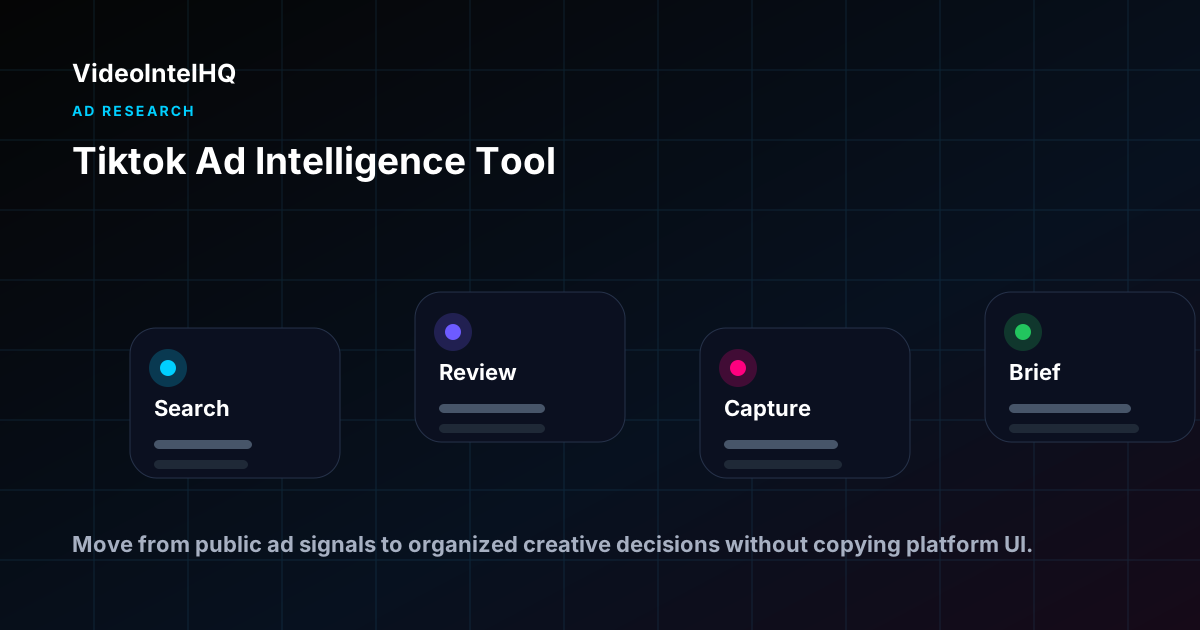
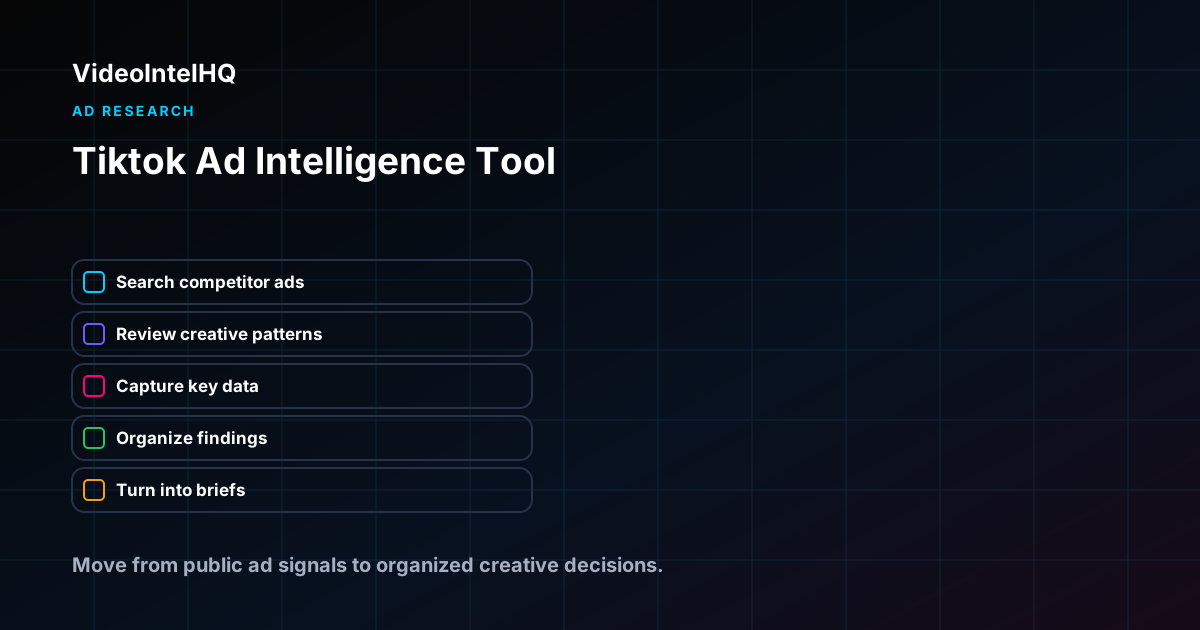
The research workflow is only as useful as what it produces. Every meaningful competitive observation should connect to one of five outcomes: save for reference, monitor for continued development, brief a differentiated hypothesis, report to a client or stakeholder, or archive as not relevant. The fifth step in any good TikTok ad intelligence workflow is the decision — not just the collection.
What to Look For in a TikTok Ad Intelligence Tool
- →Competitor monitoring by specific brand — not just a broad searchable database
- →Hook categorization and pattern tagging built into the workflow, not added manually
- →Offer and CTA tracking that captures changes over time, not just current state
- →Spend-signal or activity indicators that give creative intensity context without claiming private data
- →Creative format tagging for UGC, founder-led, demo, testimonial, and other video formats
- →Export capability for creative matrices, weekly summaries, and brief-ready outputs
- →Landing page signal support: the ability to note what the ad destination says alongside the creative
Common Research Mistakes to Avoid
- →Treating competitor ad activity as proof of ROAS, revenue, or private performance — public visibility does not confirm these
- →Copying competitor hooks directly instead of identifying the underlying pattern and adapting it
- →Building a large creative library without a tagging system — patterns become invisible in unstructured data
- →Checking competitor creative once and treating that as sufficient intelligence — patterns require time to emerge
- →Ignoring offer and landing page context when analyzing hooks — the full funnel signal is more useful than the hook alone
- →Promising clients specific outcomes from competitive research — research improves planning context, not guaranteed performance
How VideoIntelHQ Supports TikTok Ad Intelligence
VideoIntelHQ is designed specifically for the TikTok ad intelligence workflow described in this guide. Teams can set up competitor watchlists, receive weekly summaries of new creative activity and hook changes, search and filter the creative library by hook category and format type, review offer changes and CTA shifts, and export organized intelligence for briefing and reporting.
The platform does not access private TikTok ad account data, claim official platform affiliation, or guarantee creative performance outcomes. It works with public ad signals and helps teams organize those signals into a more useful research workflow. For more information, review the Features page, Pricing page, Use Cases for agencies and DTC brands, and the Resources hub.
- →Features overview available at /features
- →Pricing plans at /pricing
- →Agency use cases at /use-cases/performance-marketing-agencies
- →DTC brand use cases at /use-cases/dtc-brands
- →Resources and workflow guides at /resources
Ad intelligence workflow
Ad Research Workflow
Use this workflow to move from public competitor ad signals to a practical creative research note your team can review.
Examples by role
How teams use this workflow
Performance marketing agencies
Use tiktok ad intelligence tool: what it is and how to use one effectively to prepare client-ready weekly notes: what changed, what matters, and which original brief or review action should happen next.
DTC brands
Use tiktok ad intelligence tool: what it is and how to use one effectively to compare public creative signals against your own product, offer, landing page, and customer research before deciding what to test.
Creative teams
Use tiktok ad intelligence tool: what it is and how to use one effectively to turn scattered screenshots into structured hook, offer, proof, format, and landing-page notes that can become original briefs.
Media buyers
Use tiktok ad intelligence tool: what it is and how to use one effectively as planning context before budget and testing conversations, while avoiding unsupported claims about private ROAS, revenue, or conversions.
Key Takeaways
- →TikTok Ad Intelligence Tool: What It Is and How to Use One Effectively works best as a repeatable research workflow, not a one-time screenshot collection exercise.
- →Keep public ad observations separate from assumptions about private performance, revenue, ROAS, or account data.
- →Use the research to organize hooks, offers, formats, landing page notes, and next-step creative hypotheses.
Who This Is For
- ✓Performance marketing agencies managing TikTok competitor research across multiple client accounts
- ✓DTC brands that need systematic visibility into competitor creative, hooks, and offers
- ✓Media buyers who need creative context when making TikTok budget and test decisions
- ✓Creative strategists building hook libraries and brief-ready pattern analysis
- ✓Growth teams replacing manual TikTok scrolling with a repeatable intelligence workflow
Build from the research
Use the Operating System after you find the signal.
This guide helps you understand what to look for. The Vertical Video Growth Operating System gives you the AI skills, templates, modes, and workflows to turn that research into finished short-form videos.
Frequently Asked Questions
What is a TikTok ad intelligence tool?
A TikTok ad intelligence tool helps teams research public competitor TikTok ad creative, track hook and offer changes, analyze creative patterns, and organize findings into a searchable library — without manually scrolling competitor profiles or saving unsorted screenshots.
Does a TikTok ad intelligence tool access private ad data?
No. Tools like VideoIntelHQ work with publicly visible ad creative and activity signals. They do not access private TikTok ad accounts, private performance data, private spend figures, or backend platform data. Research based on public signals should be treated as planning input, not performance proof.
How is hook analysis useful for creative strategy?
Hook analysis organizes competitor opening patterns into categories — problem-first, before/after, offer-led, social proof, comparison, curiosity-gap — so your team can see which angles are saturated in your category, which are underused, and which are being scaled by specific competitors. This gives creative briefs a competitive foundation instead of starting from memory or scattered inspiration.
What are spend signals in TikTok ad intelligence?
Spend signals are indicators of competitor creative activity intensity based on observable behavior: how many new creatives a competitor launches, how often they rotate formats, and how consistently they repeat a specific hook or offer angle. These signals suggest where competitors are investing creative attention without claiming access to their private spend data.
How often should a team review TikTok ad intelligence?
A weekly review of new competitor creative and a monthly review of accumulated patterns gives most teams the right cadence. High-volume categories, client accounts with active campaigns, or seasonal windows may warrant more frequent monitoring. Daily checking is usually unnecessary — weekly review catches meaningful changes in time to act on them.
Can small teams use a TikTok ad intelligence tool effectively?
Yes. Small teams benefit from focused watchlists — five to eight direct competitors — reviewed on a consistent cadence. The discipline of tagging, pattern analysis, and brief connection matters more than the volume of creative collected. A small team with a focused, well-organized intelligence workflow outperforms a large team doing ad hoc manual research.
Conclusion
TikTok Ad Intelligence Tool: What It Is and How to Use One Effectively is most useful when the research is specific, documented, and connected to a clear next step. Use competitor ad tracking as planning input: monitor public signals, organize creative patterns, and turn the review into briefs or reports your team can act on without overclaiming what the data proves.
Build your TikTok ad intelligence workflow with VideoIntelHQ.
Monitor competitor creative, analyze hook patterns, track offer changes, and export organized intelligence for your team — without manual scrolling or unsorted screenshot folders.