TikTok Creative Intelligence: How to Turn Competitor Ad Patterns Into Better Creative Strategy
TikTok creative intelligence is the practice of turning systematic competitor ad research into structured creative strategy decisions. It is the difference between watching competitor ads occasionally and building an organized intelligence workflow that reveals what the market is doing, where creative angles are saturated, and which patterns deserve a differentiated response from your own team.
This guide explains what TikTok creative intelligence involves, how a creative matrix works, how to connect competitive signals to brief writing, and how to build a weekly intelligence workflow that your creative team can actually use — without copying competitor creative or claiming private performance data.
Direct answers
Quick answers for this topic
What is competitor video ad tracking?
Competitor video ad tracking is the process of monitoring publicly visible competitor video ads, recording hooks, offers, formats, CTAs, landing page context, and review dates, then using those notes to guide original creative planning without claiming private performance data.
What is the best way to organize ad research?
The best way to organize ad research is to use a consistent workflow: define the competitor set, capture public creative signals, tag each hook and offer, add landing page notes, choose a next action, and summarize meaningful changes every week.
Related workflow links
Continue the research workflow
What TikTok Creative Intelligence Actually Means
Creative intelligence is not just watching competitor ads. It is the systematic process of monitoring, categorizing, analyzing, and acting on competitor creative signals in a way that consistently improves your own team's creative decisions.
The difference between watching ads and building creative intelligence comes down to three things: structure (categorizing what you find so it becomes searchable), continuity (monitoring consistently over time so patterns emerge), and connection (translating observations into brief inputs rather than letting research die in a folder).
For TikTok specifically, creative intelligence focuses heavily on hook patterns — because hooks are the primary creative differentiator on the platform. But a complete TikTok creative intelligence system also captures offer structures, creative formats, landing page signals, and spend-signal indicators — building a full-context picture of what competitors are doing and how it changes week over week.
The Creative Matrix: The Core Output of TikTok Creative Intelligence
A creative matrix is a structured view of competitor creative organized by the dimensions that matter for creative strategy: hook pattern, creative format, offer structure, brand, and date. The matrix makes patterns visible that individual ad observation misses.
What goes in a creative matrix
Each row in a creative matrix represents one piece of competitor creative. The columns capture the dimensions your team cares about: competitor brand, date captured, hook pattern category, creative format, offer or CTA language, landing page note, and any strategic observation. When you have 30 or more rows, column-level analysis starts revealing patterns: which hook categories appear most, which formats are scaling, which offer structures are most common.
What the matrix tells you
The matrix is most useful for identifying distributions and gaps. If problem-first hooks appear in 70% of rows, the category is saturated on that pattern. If no rows use curiosity-gap hooks, there is an open creative angle. If offer-led hooks appear most frequently in the last three weeks compared to earlier in the matrix, offer competition is escalating — which might inform your own promotional strategy.
How to use the matrix in briefing
In a brief, reference the matrix to establish the competitive context: "Our hook library shows that the category is heavily weighted toward problem-first hooks, with no examples of curiosity-gap approaches in the last 60 days. This brief proposes testing a curiosity-gap hook that addresses [specific audience tension] using [brand-appropriate proof evidence]." The matrix gives the brief a foundation without the brief copying any specific competitor.
Building a TikTok Creative Intelligence System
Competitor set definition
Start with a focused competitor set: five to ten direct competitors, plus one or two adjacent brands and one or two aspirational creative references. The set should be narrow enough to review consistently every week. Expanding the set is easy; maintaining a large set consistently is harder.
Automated monitoring
Manual creative checking cannot maintain the consistency that creative intelligence requires. VideoIntelHQ automates competitor creative monitoring so new creative is captured, hooks are categorized, and offer changes are flagged without manual weekly effort. Automation is what allows the intelligence system to run consistently rather than in bursts.
Weekly structured review
The weekly review is where the intelligence workflow becomes actionable. Review the automated weekly summary, add notes to the most significant observations, flag creative worth briefing, and update the matrix with any new patterns. The weekly review should take 20–40 minutes per competitor set, not hours.
Monthly pattern analysis
Once a month, step back from the weekly detail and look at the full matrix. Measure category distributions, identify trends, and update the strategic picture of the competitive landscape. Monthly analysis is where brief strategy gets refined based on accumulated data rather than recent memory.
Brief connection
Every weekly review should identify at least one brief-worthy observation: a hook gap, an offer escalation pattern, a format rotation signal, or a landing page alignment insight. The creative intelligence system is only as valuable as the briefs it informs.
Beyond Hooks: The Full Creative Intelligence Picture
Hook patterns are the most important creative dimension to track, but a complete TikTok creative intelligence system covers more than hooks.
- →Creative format tracking: UGC, founder-led, demo, testimonial, product-close, animated text — which formats competitors are scaling and rotating
- →Offer and CTA monitoring: what promotional structures competitors are using, how they frame urgency, how CTA language changes over time
- →Landing page signal capture: what the destination page says relative to what the ad promises — hook-to-landing-page alignment is a strategic signal for creative testing
- →Spend signal indicators: activity-level patterns showing where competitors are investing creative energy — high-rotation, multi-variation testing signals creative investment
- →Seasonal creative patterns: how competitor creative changes during specific time windows — which formats and hooks appear during promotional periods versus evergreen running
- →Competitive timing signals: when competitors launch new creative relative to external events, their own product launches, or competitive category movements
The Research-to-Brief Connection
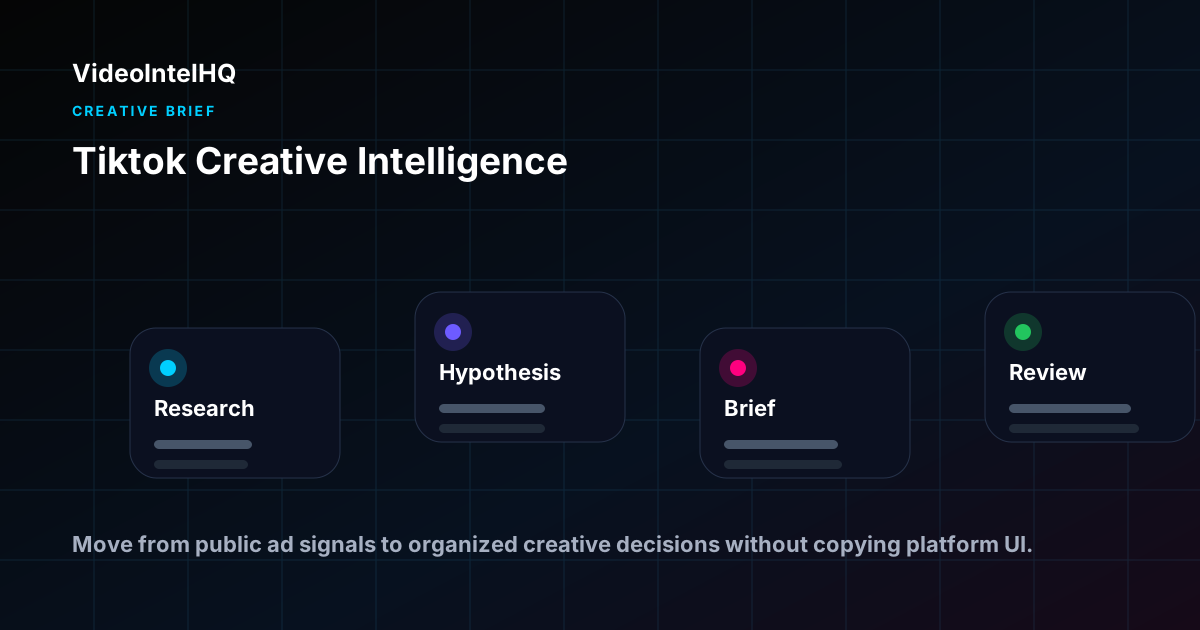
Creative intelligence is wasted if it does not connect to brief production. The connection happens in three steps.
Pattern observation
Document what is visible: which hooks competitors use, how frequently each pattern appears, which formats are scaling, and what offer structures competitors are promoting. Be precise about what is observable and what is inferred.
Strategic interpretation
Translate observations into strategic context: what does this pattern distribution mean for the competitive landscape? Where is the creative space most crowded? Where are the gaps? What seems to be escalating and what seems to be declining? Keep interpretations clearly labeled as interpretations, not facts.
Brief hypothesis
Connect the strategic interpretation to a specific creative hypothesis: given that the category is saturated on problem-first hooks and curiosity-gap is absent, test a curiosity-gap hook approach for [specific product angle] with [specific proof element] and [specific CTA framing]. The hypothesis should be specific, differentiated from the competitive set, and grounded in brand-appropriate creative execution.
Common Creative Intelligence Mistakes
- →Confusing creative pattern observation with creative performance proof — pattern visibility does not confirm ROAS or revenue
- →Copying competitor hooks or creative themes rather than using patterns to brief original differentiated creative
- →Building a large creative library without consistent tagging — unstructured data hides patterns
- →Running creative intelligence as a one-time research project rather than an ongoing weekly workflow
- →Not connecting intelligence to briefs — creative intelligence that does not produce briefs is just an organized archive
- →Over-indexing on recent creative and ignoring longitudinal patterns — recency bias produces worse pattern analysis than 60-day or 90-day library review
How VideoIntelHQ Supports TikTok Creative Intelligence
VideoIntelHQ is built to support the full TikTok creative intelligence workflow: competitor creative organization, weekly summaries of new creative and hook changes, creative matrix organization with hook and format tagging, offer tracking, and export-ready outputs for brief writing and client reporting.
The platform does not make unsupported claims about competitor performance. Creative intelligence is planning input — it informs better creative hypotheses without guaranteeing outcomes. Review the features, pricing, use cases for creative strategy teams and DTC brands, and the resources hub for more detail on how VideoIntelHQ supports the creative intelligence workflow.
Ad intelligence workflow
Ad Research Workflow
Use this workflow to move from public competitor ad signals to a practical creative research note your team can review.
Examples by role
How teams use this workflow
Performance marketing agencies
Use tiktok creative intelligence: how to turn competitor ad patterns into better creative strategy to prepare client-ready weekly notes: what changed, what matters, and which original brief or review action should happen next.
DTC brands
Use tiktok creative intelligence: how to turn competitor ad patterns into better creative strategy to compare public creative signals against your own product, offer, landing page, and customer research before deciding what to test.
Creative teams
Use tiktok creative intelligence: how to turn competitor ad patterns into better creative strategy to turn scattered screenshots into structured hook, offer, proof, format, and landing-page notes that can become original briefs.
Media buyers
Use tiktok creative intelligence: how to turn competitor ad patterns into better creative strategy as planning context before budget and testing conversations, while avoiding unsupported claims about private ROAS, revenue, or conversions.
Related Wade Digital tools
Adjacent workflows to review
These are related Wade Digital tools only where they naturally support the workflow. VideoIntelHQ remains focused on competitor video ad intelligence.
Key Takeaways
- →TikTok Creative Intelligence: How to Turn Competitor Ad Patterns Into Better Creative Strategy works best as a repeatable research workflow, not a one-time screenshot collection exercise.
- →Keep public ad observations separate from assumptions about private performance, revenue, ROAS, or account data.
- →Use the research to organize hooks, offers, formats, landing page notes, and next-step creative hypotheses.
Who This Is For
- ✓Creative strategy teams building brief-ready intelligence libraries from competitor TikTok research
- ✓Performance marketing agencies delivering structured creative intelligence to clients
- ✓DTC brands wanting systematic visibility into how category creative is evolving
- ✓Media buyers who need creative context to inform TikTok testing and budget decisions
- ✓Growth teams replacing ad hoc inspiration-gathering with a repeatable creative intelligence system
Build from the research
Use the Operating System after you find the signal.
This guide helps you understand what to look for. The Vertical Video Growth Operating System gives you the AI skills, templates, modes, and workflows to turn that research into finished short-form videos.
Frequently Asked Questions
What is TikTok creative intelligence?
TikTok creative intelligence is the practice of systematically researching competitor TikTok ad creative, categorizing hook patterns, offer structures, and creative formats, and translating those organized signals into better creative strategy decisions. It is the difference between watching competitor ads occasionally and building a structured system that consistently informs brief writing and creative testing.
What is a creative matrix?
A creative matrix is a structured view of competitor creative organized by dimensions relevant to creative strategy: hook pattern, creative format, offer or CTA language, brand, and date. The matrix makes patterns visible that individual ad observation misses, enabling the team to identify which hook categories are saturated, which formats are scaling, and which angles are absent from the competitive landscape.
How long does building a useful creative intelligence system take?
The system starts producing useful signals immediately, but the most valuable pattern analysis typically emerges after six to eight weeks of consistent monitoring. After eight weeks, the creative matrix has enough data to identify longitudinal patterns — hook category distributions, format rotation trends, offer escalation signals — that inform brief strategy rather than just providing creative inspiration.
How does creative intelligence connect to the brief writing process?
Creative intelligence informs the competitive context section of a brief: which hook patterns are saturated in the category, which creative angles are absent or underused, and which offer structures are most common. The brief uses this context to establish a differentiated creative hypothesis — a specific angle to test that is grounded in the competitive landscape without copying any specific competitor.
Can creative intelligence predict which ads will win?
No. Creative intelligence provides better planning context and helps teams form more differentiated creative hypotheses. It cannot predict ad performance because performance depends on offer quality, audience targeting, landing page conversion, budget, timing, and many other factors outside the creative research. Use intelligence to improve the quality of what your team tests, not to guarantee the outcome.
Is VideoIntelHQ appropriate for solo creative strategists or only teams?
Both. Solo strategists use VideoIntelHQ to build personal hook libraries, track competitor creative changes, and connect research to their brief writing workflow without manual scrolling. Agency and brand teams use the multi-client and team-access features to scale the same workflow across accounts and contributors.
Conclusion
TikTok Creative Intelligence: How to Turn Competitor Ad Patterns Into Better Creative Strategy is most useful when the research is specific, documented, and connected to a clear next step. Use competitor ad tracking as planning input: monitor public signals, organize creative patterns, and turn the review into briefs or reports your team can act on without overclaiming what the data proves.
Build your TikTok creative intelligence system with VideoIntelHQ.
Monitor competitor hooks, formats, and offers automatically. Build a searchable creative matrix your team can use to write better briefs and make better creative testing decisions.