TikTok Hook Analysis Tool: Build a Competitor Hook Library That Actually Informs Your Briefs
The first three seconds of a TikTok ad determine whether a viewer keeps watching or swipes past. That makes hook analysis the most important creative research task for any team running or planning TikTok ads. A TikTok hook analysis tool helps creative strategists systematically capture, categorize, and build a searchable library of competitor hooks — so the brief writing process starts from pattern intelligence rather than from whatever was seen most recently.
This guide explains how hook analysis works, what categories matter most, how to build a hook library over time, and how to translate hook patterns into better creative briefs — without copying competitor hooks directly or making unsupported claims about what is working in the market.
Direct answers
Quick answers for this topic
What is competitor video ad tracking?
Competitor video ad tracking is the process of monitoring publicly visible competitor video ads, recording hooks, offers, formats, CTAs, landing page context, and review dates, then using those notes to guide original creative planning without claiming private performance data.
How do you track ad hooks?
Track ad hooks by saving the first three seconds of each public video ad, tagging the hook type, noting the audience problem or promise, recording whether the hook changed, and turning the pattern into an original test hypothesis.
What is the best way to organize ad research?
The best way to organize ad research is to use a consistent workflow: define the competitor set, capture public creative signals, tag each hook and offer, add landing page notes, choose a next action, and summarize meaningful changes every week.
Related workflow links
Continue the research workflow
Why Hooks Matter More on TikTok Than Anywhere Else
TikTok's algorithm is designed to surface content users want to keep watching. Ads that fail to keep viewers engaged in the first few seconds get distributed less — which is why creative performance on TikTok is disproportionately determined by the hook compared to other platforms where context, audience targeting, and creative polish all play larger roles.
This changes how competitive creative research should work. On display advertising, you might spend most research time analyzing the visual design, offer structure, or landing page. On TikTok, you spend most research time analyzing how the creative opens — the first words spoken, the first visual shown, the implied promise that makes a viewer stop the scroll and watch more.
Competitor hook analysis is the systematic version of this research. Instead of randomly watching competitor ads and noting what felt interesting, hook analysis builds a structured record of what every tracked competitor uses to open their TikTok ads, categorized in a way that reveals patterns across the competitive set.
The Hook Pattern Categories That Matter
Not all hooks are created equal, and not all hook categories work the same way. Understanding the main hook patterns helps you build a useful library instead of just a pile of first-three-second video clips.
Problem-first hooks
Problem-first hooks open by naming a specific pain point the target viewer experiences. The appeal is recognition: the viewer immediately identifies with the problem, which creates a reason to keep watching for the solution. Examples: "If your skin feels tight and dry every morning, this is for you" or "Stop wasting hours manually scrolling competitor ads every week." Problem-first hooks are the most common category in most verticals — which means they can become saturated and lose impact when every competitor uses the same pattern.
Before/after contrast hooks
Before/after hooks open by establishing a clear contrast between the current situation and a desired outcome. The appeal is aspiration — the hook establishes the gap and implies the product bridges it. These hooks work well for products with visible transformations: physical results, workflow improvements, financial changes. They struggle when the transformation is abstract or when the before state is unclear.
Offer-led hooks
Offer-led hooks open with the promotional incentive: a discount percentage, a bundle deal, a limited-time offer, or a free-trial framing. The appeal is immediate value — the hook establishes that something valuable is available right now. Offer-led hooks tend to attract high intent viewers but can attract low-quality audiences if the offer is the only appeal. They work best when the offer is genuinely strong and time-limited.
Social proof hooks
Social proof hooks open with a credibility signal: a large customer count, a visible result from a real user, a recognizable endorsement, or a specific testimony. The appeal is third-party validation — the hook establishes that others have already found this product valuable. Social proof hooks work well for categories where trust is a purchase barrier.
Curiosity-gap hooks
Curiosity-gap hooks withhold just enough information to make the viewer feel they need to watch more to understand. "What I found after tracking 40 competitor ads in 30 days" or "The hook pattern no one in this category is using yet" — these create an itch that only the rest of the video can scratch. Curiosity-gap hooks are relatively underused in most categories and can create strong pattern differentiation when competitors all use problem-first approaches.
Comparison hooks
Comparison hooks position the product or approach explicitly against an alternative or a commonly held expectation. "We tested six different skincare routines — here is what actually worked" or "Every other approach to this problem does X — we do Y differently." Comparison hooks require confidence in the positioning and work best when the comparison is fair and the difference is genuine.
Building Your Competitor Hook Library
A hook library is a structured, searchable collection of competitor hooks organized by pattern, brand, and date. It becomes more valuable the longer it runs because it reveals trends that point-in-time research cannot. Here is how to build one effectively.
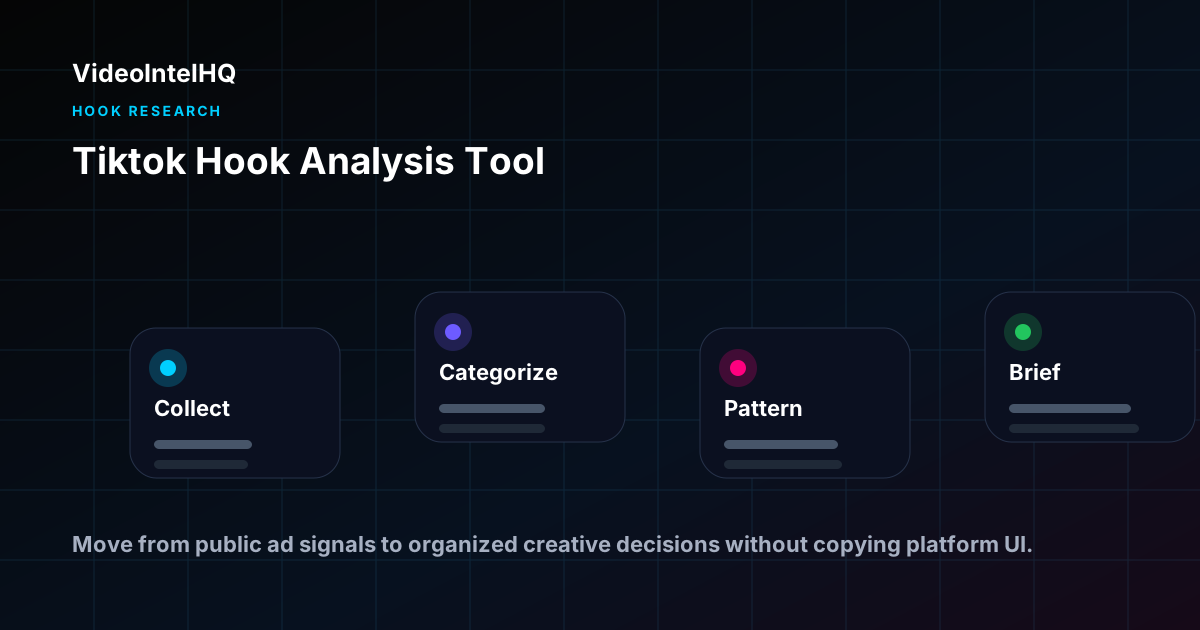
Step 1: Define your competitor set
Start with direct competitors and category leaders — the brands whose TikTok creative is most relevant to your strategic decisions. Five to ten brands is manageable for weekly review. Add a few adjacent brands if their creative patterns might inform yours.
Step 2: Set up systematic monitoring
Use VideoIntelHQ to monitor your competitor set automatically. New creative is captured when it becomes publicly visible. You receive weekly summaries of new creative and hook changes across all tracked brands.
Step 3: Categorize every hook you capture
For every piece of new competitive creative, categorize the hook: what is the pattern category, what is the specific opening line or visual, what audience problem or desire does it address, and what proof or offer follows the hook. Consistent categorization is what makes the library useful — without it, you have a pile of videos, not a pattern library.
Step 4: Review monthly for pattern emergence
Monthly review of the hook library reveals which categories are growing, which are shrinking, and which are absent. After two or three months of consistent monitoring, you will be able to identify category saturation points and creative differentiation opportunities with real data behind the observation.
Hook Pattern Analysis: What to Look For
- →Category distribution: what percentage of competitor hooks fall into each pattern? High concentration in one category signals possible saturation
- →Brand-specific patterns: which brands repeat which hook patterns? Repetition signals the patterns that brand believes work in their testing
- →Emerging patterns: which hook categories are growing across multiple competitors this month that were not present last month?
- →Absent patterns: which hook categories are completely absent from the competitive landscape? Absence can indicate opportunity
- →Seasonal patterns: which hook categories appear more frequently during specific time windows? Seasonal hooks often signal promotional intent
- →Format correlation: which hook patterns work with which creative formats? Problem-first hooks often pair with UGC; comparison hooks often pair with demonstration-style creative
Translating Hook Analysis Into Better Briefs
Hook analysis is only as useful as how it connects to your creative briefs. Here is how to translate organized hook pattern data into better brief inputs.
Identify the saturation point
If 80% of competitive hooks in your category are problem-first, the market is saturated on that pattern. The saturation point does not mean problem-first hooks are bad — it means the marginal differentiation value of another problem-first hook is lower than it was when fewer competitors used the pattern. A brief built on a different pattern has more open creative territory.
Find the gap
The most valuable output of a hook library is identifying the creative angle that is underrepresented or absent in the competitive landscape. If no competitor uses curiosity-gap hooks and the category is saturated with problem-first, a curiosity-gap hook test has creative differentiation built in before the creative is even produced.
Brief the pattern, not the line
Do not copy competitor hook lines. Brief the underlying pattern and adapt it to your own brand, product, and audience. "We noticed three competitors are using before/after contrast hooks effectively. For our brief, we want to test a before/after hook specific to [customer pain point] using [brand-appropriate proof evidence]." That is how research translates into original creative.
Hook Analysis Mistakes to Avoid
- →Copying competitor hook lines directly — use patterns as inspiration, not as scripts
- →Building a hook library without date and brand attribution — patterns require temporal and source context
- →Treating hook repetition as proof of performance — a competitor repeating a hook pattern signals their creative investment, not verified ROAS or revenue
- →Focusing only on hooks and ignoring offer and landing page context — the full funnel picture matters for interpreting hook effectiveness
- →Building the library without reviewing it monthly — point-in-time collection without periodic pattern review misses the longitudinal value
- →Overweighting one category because it is memorable — systematic counting across the full library prevents recency and availability bias
How VideoIntelHQ Supports Hook Analysis
VideoIntelHQ's hook tracking workflow is built for the approach described in this guide. Competitors are monitored automatically for new creative, hooks are categorized by pattern type in the creative library, and weekly summaries surface new hooks and pattern changes across all tracked brands. The creative matrix is searchable by hook category, making gap analysis practical after four to eight weeks of monitoring.
VideoIntelHQ does not claim that hook visibility proves competitor performance. Hook pattern data is research input — it informs brief writing and creative strategy decisions without guaranteeing any outcome. For agency teams, each client account gets a separate hook library. For brand teams, the hook library grows across the competitive set over time. Review the features, pricing, and use cases pages for more detail on how the hook analysis workflow works in VideoIntelHQ.
Hook analysis board
Hook Pattern Review
Use this table to separate a hook pattern from the exact wording in a competitor ad. The goal is to understand the opening move, the risk, and the next test idea.
Examples by role
How teams use this workflow
Performance marketing agencies
Use tiktok hook analysis tool: build a competitor hook library that actually informs your briefs to prepare client-ready weekly notes: what changed, what matters, and which original brief or review action should happen next.
DTC brands
Use tiktok hook analysis tool: build a competitor hook library that actually informs your briefs to compare public creative signals against your own product, offer, landing page, and customer research before deciding what to test.
Creative teams
Use tiktok hook analysis tool: build a competitor hook library that actually informs your briefs to turn scattered screenshots into structured hook, offer, proof, format, and landing-page notes that can become original briefs.
Media buyers
Use tiktok hook analysis tool: build a competitor hook library that actually informs your briefs as planning context before budget and testing conversations, while avoiding unsupported claims about private ROAS, revenue, or conversions.
Related Wade Digital tools
Adjacent workflows to review
These are related Wade Digital tools only where they naturally support the workflow. VideoIntelHQ remains focused on competitor video ad intelligence.
Key Takeaways
- →TikTok Hook Analysis Tool: Build a Competitor Hook Library That Actually Informs Your Briefs works best as a repeatable research workflow, not a one-time screenshot collection exercise.
- →Keep public ad observations separate from assumptions about private performance, revenue, ROAS, or account data.
- →Use the research to organize hooks, offers, formats, landing page notes, and next-step creative hypotheses.
Who This Is For
- ✓Creative strategists building hook libraries to inform TikTok creative briefs
- ✓Performance marketing agencies tracking hook patterns across client competitor sets
- ✓DTC brands wanting systematic visibility into how competitors open their TikTok ads
- ✓Media buyers who want hook pattern context before making creative testing decisions
- ✓Content strategists analyzing what opening patterns are most common in their market category
Build from the research
Use the Operating System after you find the signal.
This guide helps you understand what to look for. The Vertical Video Growth Operating System gives you the AI skills, templates, modes, and workflows to turn that research into finished short-form videos.
Frequently Asked Questions
What is a TikTok hook analysis tool?
A TikTok hook analysis tool helps creative teams systematically capture and categorize the opening patterns of competitor TikTok ads — the first three seconds that determine viewer retention. It builds a searchable library of hook patterns organized by category, brand, and date, enabling pattern-based brief writing instead of point-in-time inspiration.
What are the main TikTok hook pattern categories?
The main hook categories are: problem-first (naming a specific viewer pain point), before/after contrast (establishing the gap between current and desired state), offer-led (opening with a promotional incentive), social proof (opening with a credibility signal), curiosity-gap (withholding information to create a reason to keep watching), and comparison (positioning against an alternative or expectation). Most categories produce distinct audience responses and work better in different contexts.
How long does it take to build a useful hook library?
Four to eight weeks of consistent competitor monitoring gives most teams enough data to identify meaningful hook pattern distributions. After eight weeks, you can start identifying which categories are saturated, which are emerging, and which are absent in your category. The library becomes more valuable the longer it runs because it reveals longitudinal trends.
Can I use competitor hook patterns directly in my creative briefs?
You can use the patterns as brief inputs — the hook category and the audience problem or desire it addresses. You should not copy the specific hook lines from competitor ads. Brief the pattern and adapt it to your own brand voice, product proof points, and audience context. Original differentiated creative built on pattern intelligence outperforms direct copies in both creative performance and brand integrity.
Does seeing a competitor repeat a hook pattern mean it is working?
Repetition is a signal worth noting but not proof of performance. A competitor repeating a hook pattern suggests they are investing in that angle — but it does not confirm their ROAS, revenue, or private performance metrics. Track repetition as an input to your research while being careful not to present it as verified evidence of effectiveness.
How many hooks should I track per competitor?
All publicly visible hooks from your tracked competitors, categorized consistently. The point is not to limit collection but to ensure every collected hook has a pattern tag, brand attribution, and date. A well-organized library of 200 categorized hooks is dramatically more useful than a folder of 1,000 untagged screenshots.
Conclusion
TikTok Hook Analysis Tool: Build a Competitor Hook Library That Actually Informs Your Briefs is most useful when the research is specific, documented, and connected to a clear next step. Use competitor ad tracking as planning input: monitor public signals, organize creative patterns, and turn the review into briefs or reports your team can act on without overclaiming what the data proves.
Build your TikTok hook library with VideoIntelHQ.
Monitor competitor hooks automatically, categorize patterns by angle, and build a searchable hook intelligence library your creative team can actually use for briefing.