UGC Ad Format Research for Creative Strategy
UGC Ad Format Research for Creative Strategy gives creative strategists building UGC production briefs a practical way to study UGC ad formats such as testimonial, review, demo, comparison, and problem-solution videos without turning competitor research into random scrolling. The fastest useful answer is this: track the first seconds, the format, the offer, the proof, and the CTA in a consistent structure, then convert repeated patterns into differentiated test hypotheses.
This guide is built for public ad signal research on short-form video platforms. It does not assume private ad account access, hidden platform data, or guaranteed performance. VideoIntelHQ helps teams organize competitor video ad research, monitor hook and offer changes, and prepare clearer creative briefs. Results still depend on offer, audience, creative quality, budget, landing page, tracking, and execution.
Direct answers
Quick answers for this topic
What is competitor video ad tracking?
Competitor video ad tracking is the process of monitoring publicly visible competitor video ads, recording hooks, offers, formats, CTAs, landing page context, and review dates, then using those notes to guide original creative planning without claiming private performance data.
What is the best way to organize ad research?
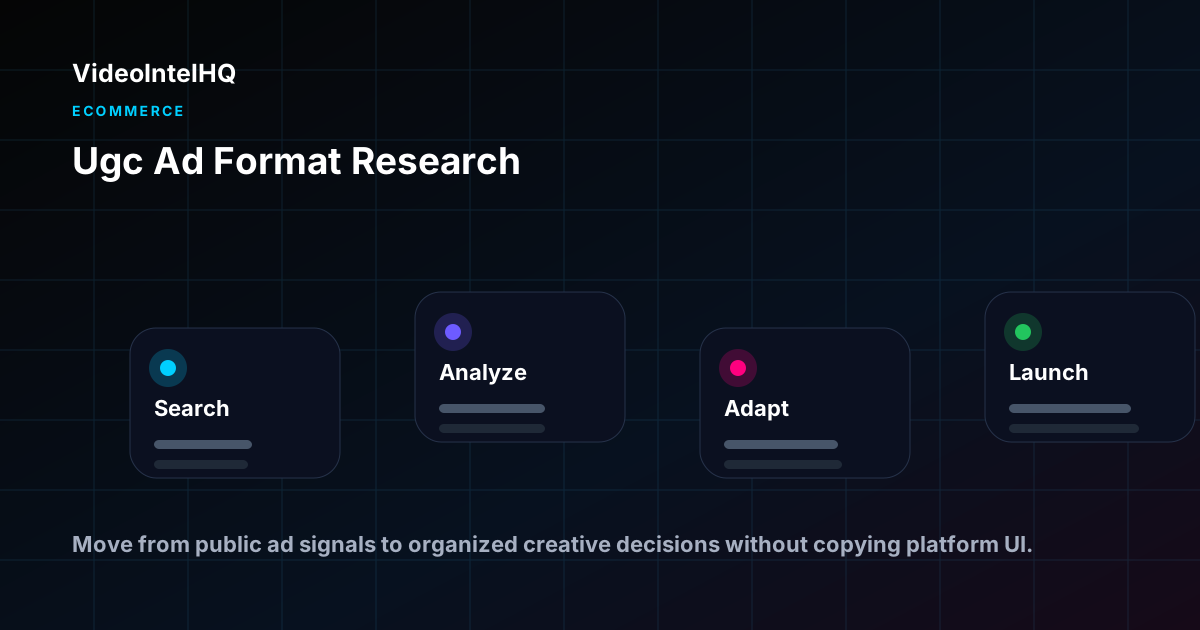
The best way to organize ad research is to use a consistent workflow: define the competitor set, capture public creative signals, tag each hook and offer, add landing page notes, choose a next action, and summarize meaningful changes every week.
Related workflow links
Continue the research workflow
Why UGC Ad Format Research for Creative Strategy Matters for Your Team
UGC Ad Format Research for Creative Strategy addresses a specific gap that many ugc ads teams encounter: the gap between knowing that competitive research is valuable and actually having a research workflow that produces consistent, actionable intelligence without becoming a time-sink. The teams that get this right treat ugc ad format research as a repeatable process rather than a one-time project — which is why the structure matters as much as the tool.
When a team starts treating ugc ad format research as infrastructure rather than an occasional task, several things change. The research becomes more consistent because the workflow has a defined cadence. The intelligence becomes more useful because findings are organized in a searchable structure rather than scattered across screenshots and notes. The briefs improve because they are grounded in pattern-level observations from the research library rather than whatever creative was seen most recently.
This distinction — infrastructure vs. project — is the difference between teams that build genuine competitive intelligence over time and teams that periodically rediscover what their competitors are doing without ever accumulating an organized knowledge base.
A Practical Framework for Getting Started
Whether UGC Ad Format Research for Creative Strategy is new to your team or an existing process that needs better structure, a practical starting framework has five components:
1. Define what you are researching: which competitors, which platforms, which specific signals (hooks, offers, formats, landing pages, or all of the above). A clear scope prevents the research from becoming too broad to review consistently.
2. Set up a monitoring cadence that matches your team's production cycle. Weekly reviews work for active paid social programs. Monthly reviews are better for stable categories or teams with longer creative production timelines.
3. Use consistent classification tags for every entry in your research library. Hook patterns, offer structures, and creative formats should use the same taxonomy across all entries. Consistency is what makes the library searchable for pattern analysis.
4. Connect every observation to a next step: brief a differentiated test, monitor for pattern development, report to stakeholders, or archive as noise. Research without a decision framework grows without producing value.
5. Review the system quarterly: which competitors are still relevant, which classification categories are useful, and whether the output formats still match what the team needs.
- →Start with the specific competitors and signals that matter most for your current brief and testing cycle
- →Use consistent tags for hook patterns, offer structures, and creative formats across all entries
- →Connect each observation to a decision: brief, monitor, report, or archive
- →Review and refine the system quarterly to keep it aligned with team needs
Manual vs. Structured: How UGC Ad Format Research for Creative Strategy Changes Your Workflow
Most teams start UGC Ad Format Research for Creative Strategy with a manual process: checking competitor pages, saving screenshots, and discussing findings in meetings or chat threads. This approach works for a one-off review but breaks down when the team needs consistent intelligence across multiple competitors, clients, or review periods.
The manual approach
Manual competitor research typically involves checking three to five competitor profiles or the TikTok Creative Center on a weekly basis, saving interesting ads to a folder or Notion page, and discussing findings in a team meeting or chat thread. The manual approach works for initial discovery but has structural limitations: no automated alerts mean new creative can go unnoticed between manual checks, screenshots lack consistent classification tags needed for pattern analysis, findings are hard to search or compare across review periods, and the research output is often a conversation rather than a structured deliverable.
The structured approach with VideoIntelHQ
A structured approach using VideoIntelHQ replaces manual checking with automated competitor monitoring. New creative is captured as it appears, classified with consistent hook and offer tags, and organized into a searchable library that grows more valuable over time. Weekly summaries consolidate the most important observations for each competitor or client account, and the research library supports longitudinal analysis that manual methods cannot match. The structured approach does not require more time — it requires different time allocation. Instead of spending two hours manually checking competitor profiles, the team spends thirty minutes reviewing organized weekly summaries and tagging new entries into the library. The remaining ninety minutes goes into analysis, brief writing, and strategic discussions rather than data collection.
The Main Creative Format Categories in Paid Social Video
Creative format research requires a stable taxonomy before consistent tracking is possible. The most common format categories in paid social video advertising are:
**UGC (User-Generated Content style)**: Produced to look like authentic consumer content — handheld camera, natural lighting, conversational delivery. Often (but not always) featuring real customers.
**Founder-led**: The brand founder or a recognizable authority figure speaks directly to camera. Combines product credibility with personal trust.
**Product demonstration**: The product itself is the focus — a hands-on demonstration of functionality, application, or use case without a central spokesperson.
**Testimonial**: A customer or user shares their specific experience or result. Often structured as before/after or problem/solution.
**Comparison**: The ad explicitly compares the product to an alternative — a competitor, a category default, or a prior approach.
**Talking-head / interview style**: A single person speaks to camera in a controlled or editorial setting, different from UGC in production quality and presentation.
How Format Choice Affects Hook Structure
Different creative formats create different constraints and opportunities for the hook. A UGC-style format can open with an unpolished, naturalistic hook that would feel incongruent in a high-production testimonial spot. A founder-led format creates authority in the hook that product demo formats cannot match in the first three seconds.
Researching competitor format choices alongside their hook choices reveals a more complete picture: not just what hook patterns competitors are using, but which format makes each hook pattern land most effectively in the category.
- →UGC formats pair most naturally with problem-first and before/after hooks — they feel relatable and immediate
- →Founder-led formats work well with curiosity-gap and authority-based hooks — the format itself signals expertise
- →Demo formats pair best with reveal hooks and comparison hooks — the product is the proof element
- →Testimonial formats work most effectively with social proof hooks and transformation hooks
- →Comparison formats align naturally with comparison hooks and competitive positioning hooks
Category-Level Format Distribution: Reading the Competitive Landscape
The distribution of creative formats across the competitive set reveals strategic patterns that individual ads cannot. A category where 70% of competitor creative is UGC-style has reached format saturation — UGC no longer provides creative differentiation, and a founder-led or demo format from your brand would stand out in the feed.
A category where formats are evenly distributed across UGC, founder-led, demo, and testimonial is in a healthy state of creative variety, where each format can still differentiate. A category where a new format is emerging — for example, comparison ads becoming more common — may be in transition as competitors respond to creative fatigue with the previously dominant format.
Track the monthly format distribution in a simple chart: what percentage of competitor creative uses each format? When a format crosses 50% of the distribution, it has reached competitive saturation. When a format drops below 10%, it may represent a differentiation opportunity — or it may be genuinely less effective in the category.
Tracking Format Rotation Signals
Format rotation happens when a competitor shifts from one dominant creative format to another across their visible ad inventory. Rotation signals are worth tracking because they often reflect something changing in the brand's creative strategy — a response to creative fatigue, a test of a new format, or a response to performance data the brand has internally.
High-rotation signals
When a competitor releases three or more new creatives in different formats within two weeks, they are likely in an active format-testing period. Flag this as high-rotation and note which formats appear in the rotation.
Format consolidation signals
When a competitor appears to settle on one format after a period of rotation — running the same format consistently for four or more weeks — they may have found a format that is working in their testing. Note the format and monitor whether the hook and offer pattern within that format also stabilizes.
Format Research to Brief Connection
- →Identify which formats are overrepresented in the category — a saturated format is a differentiation opportunity
- →Note which format is absent or rare — an absent format is a potential first-mover creative angle
- →Brief the format alongside the hook — they are inseparable in production and performance
- →Document format rotation patterns per competitor to understand their creative testing rhythm
- →Use format research to inform production decisions, not just hook decisions — format choice affects production cost, timeline, and the type of creative talent required
Creative testing matrix
DTC Creative Testing Matrix
For ecommerce and DTC teams, the useful signal is how product angle, offer, proof, and objection handling work together across public creative.
Examples by role
How teams use this workflow
Performance marketing agencies
Use ugc ad format research for creative strategy to prepare client-ready weekly notes: what changed, what matters, and which original brief or review action should happen next.
DTC brands
Use ugc ad format research for creative strategy to compare public creative signals against your own product, offer, landing page, and customer research before deciding what to test.
Creative teams
Use ugc ad format research for creative strategy to turn scattered screenshots into structured hook, offer, proof, format, and landing-page notes that can become original briefs.
Media buyers
Use ugc ad format research for creative strategy as planning context before budget and testing conversations, while avoiding unsupported claims about private ROAS, revenue, or conversions.
Related Wade Digital tools
Adjacent workflows to review
These are related Wade Digital tools only where they naturally support the workflow. VideoIntelHQ remains focused on competitor video ad intelligence.
Key Takeaways
- →UGC Ad Format Research for Creative Strategy works best as a repeatable research workflow, not a one-time screenshot collection exercise.
- →Keep public ad observations separate from assumptions about private performance, revenue, ROAS, or account data.
- →Use the research to organize hooks, offers, formats, landing page notes, and next-step creative hypotheses.
Who This Is For
- ✓Performance marketing agencies building client creative research workflows
- ✓DTC and ecommerce brands planning short-form video ad tests
- ✓Creative strategists organizing hooks, offers, proof, and UGC patterns
- ✓Media buyers who need better creative context before allocating test budget
- ✓Founders, growth marketers, and freelancers building repeatable ad research systems
Build from the research
Use the Operating System after you find the signal.
This guide helps you understand what to look for. The Vertical Video Growth Operating System gives you the AI skills, templates, modes, and workflows to turn that research into finished short-form videos.
Frequently Asked Questions
What is ugc ad format research for creative strategy?
It is a structured workflow for reviewing public short-form video platforms ad signals, tagging UGC ad formats such as testimonial, review, demo, comparison, and problem-solution videos, and turning repeated patterns into creative briefs or testing ideas.
Does VideoIntelHQ access private ad data?
No. VideoIntelHQ helps organize public ad signals and creative research workflows. It does not provide unauthorized access to private ad accounts, backend platform data, or private competitor metrics.
Can this research guarantee better ad performance?
No. Research can improve planning quality, but performance depends on the offer, audience, creative execution, budget, landing page, tracking, and campaign setup.
How often should teams run this workflow?
Weekly reviews work well for active paid social programs. Monthly reviews are useful for deeper pattern analysis, client reporting, creative strategy meetings, and library cleanup.
Should teams copy competitor hooks or UGC formats?
No. Use competitor research to identify patterns and develop differentiated hypotheses. Direct copying creates brand, legal, and strategic risk.
How many creative formats should I track per competitor?
Track all visible formats from your tracked competitors, organized by brand and date. The goal is to identify format preferences and rotation patterns, not to create a comprehensive archive of every ad. Consistent format tagging on every entry in your research library is what makes format analysis practical.
What signals that a creative format is becoming saturated in a category?
Format saturation is indicated when more than 60-70% of competitor creatives in the category use the same format consistently for four or more weeks. Saturation does not mean the format stops working, but it does mean that using the same format no longer creates creative differentiation — the format becomes table stakes rather than a competitive advantage.
Should I track format alongside hook or separately?
Always track them together. A hook analysis without format context is incomplete because the same hook pattern produces very different creative outcomes in different formats. The combination of hook category and creative format is what the brief should specify — and therefore what the research should capture.
Conclusion
UGC Ad Format Research for Creative Strategy is most useful when the research is specific, documented, and connected to a clear next step. Use competitor ad tracking as planning input: monitor public signals, organize creative patterns, and turn the review into briefs or reports your team can act on without overclaiming what the data proves.
Build a cleaner video ad research workflow with VideoIntelHQ.
Monitor public competitor ad signals, organize hooks and offers, and turn short-form video research into creative briefs, swipe files, reports, and testing plans.