TikTok Ad Monitoring for Agencies: Building a Scalable Multi-Client Competitive Intelligence Workflow
TikTok ad monitoring for agencies is fundamentally different from monitoring for an individual brand or in-house team. Agencies manage multiple client accounts simultaneously, each requiring a separate competitive intelligence workflow: its own competitor set, its own research library, its own weekly deliverable, and its own brief-writing pipeline. The challenge is not understanding how to research competitor TikTok ads — it is building a system that scales across five, ten, or fifteen client accounts without proportionally multiplying the hours spent on manual research.
This guide explains how to structure TikTok ad monitoring for an agency context, what a scalable multi-client competitive intelligence workflow looks like, what deliverables agencies should produce from the research, and how VideoIntelHQ supports the agency workflow specifically.
Direct answers
Quick answers for this topic
What is competitor video ad tracking?
Competitor video ad tracking is the process of monitoring publicly visible competitor video ads, recording hooks, offers, formats, CTAs, landing page context, and review dates, then using those notes to guide original creative planning without claiming private performance data.
What is the best way to organize ad research?
The best way to organize ad research is to use a consistent workflow: define the competitor set, capture public creative signals, tag each hook and offer, add landing page notes, choose a next action, and summarize meaningful changes every week.
Related workflow links
Continue the research workflow
The Agency Monitoring Challenge
The average performance marketing agency managing TikTok client accounts spends between two and six hours per client per week on manual competitor creative checking when no systematic monitoring tool is in place. For an agency with ten clients, that is twenty to sixty hours per week of manual research — a significant operational burden that often falls on senior team members who should be spending their time on strategy rather than scrolling.
The problem compounds because manual research is inconsistent. Some clients get thorough weekly research. Others get a quick check. New creative that launches on Tuesday might not be captured until the following Monday. Offer changes get missed between review cycles. Hook pattern shifts that would inform a brief go unnoticed until a competitor has been running a new angle for weeks.
Scalable TikTok ad research for agencies requires a consistent review workflow so that consistent coverage happens for every client account every week without proportional headcount increase.
Setting Up Multi-Client Monitoring in VideoIntelHQ
Step 1: Create separate workspaces per client
Each client account should have its own dedicated competitor watchlist and creative intelligence library in VideoIntelHQ. Mixing competitor data across clients creates confusion and potential conflict-of-interest risks. Separate workspaces ensure that every research decision, alert, and export is clearly attributed to the right client context.
Step 2: Define the competitor set for each client
Work with each client account manager to define the right competitor set: direct competitors in the same category, adjacent brands with similar audiences, and one or two aspirational creative references. Keep the per-client watchlist to five to twelve brands — large enough to reveal patterns, small enough to review consistently every week.
Step 3: Configure the review workflow
Once competitor watchlists are defined in VideoIntelHQ, your team reviews and organizes competitor creatives each cycle. New competitor creative is captured as your team reviews it. Hook changes are logged. Offer language shifts are flagged. Spend signal indicators are noted based on creative activity patterns. Your team produces weekly summaries per client account from the organized research.
Step 4: Assign account management responsibilities
Define who reviews and annotates the weekly summary for each client. Junior analysts can handle initial tagging and summary review. Account managers and media buyers review the annotated output and make strategic recommendations. Creative strategists pull from the organized library when preparing briefs. The structured workflow scales across team roles without requiring senior oversight of every step.
Step 5: Establish delivery cadence
Decide when and how each client receives competitive intelligence. Weekly email summaries work for most clients. Monthly pattern analysis presentations work for strategic planning conversations. Quarterly landscape reviews work for deeper category assessment. Match the delivery cadence to the client's decision cadence, not just what is convenient for the agency.
The Weekly Agency Monitoring Workflow
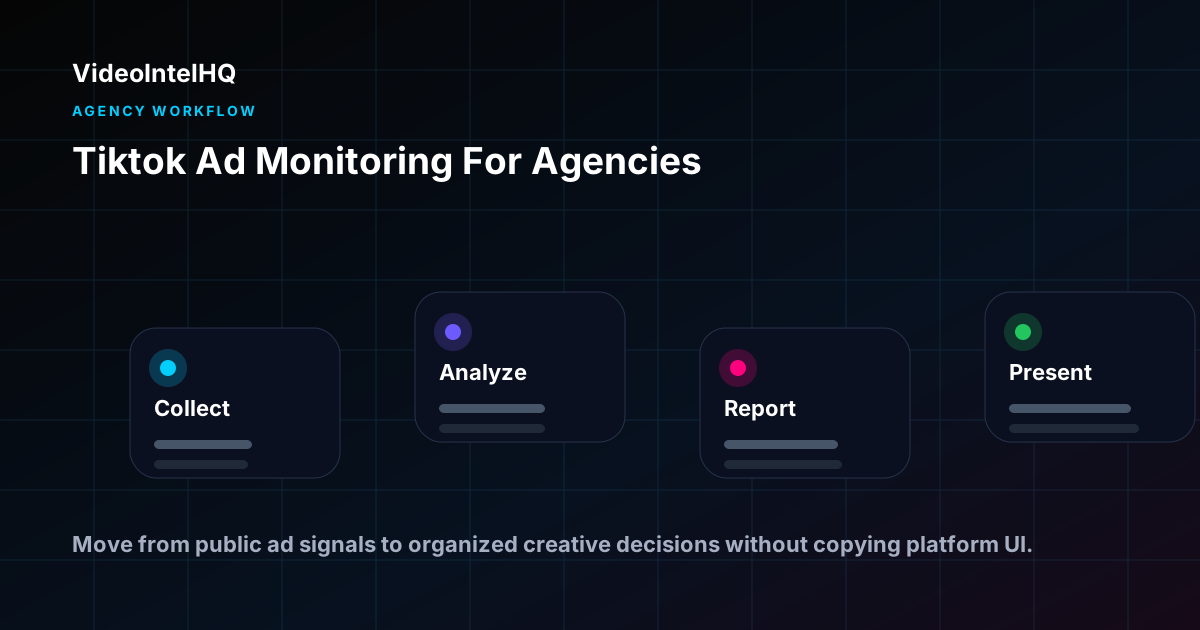
A practical weekly TikTok ad monitoring workflow for an agency client account runs in four phases.
Monday: Summary review
Account managers review the weekly summary for each client account. The summary covers new competitor creative, hook pattern shifts, offer language changes, and spend-signal updates from the past seven days. Review time per client account: 15–30 minutes with VideoIntelHQ, versus 60–120 minutes without a structured workflow.
Monday/Tuesday: Annotation and flagging
Annotate the most significant observations: which new creative is worth saving, which hook or offer changes deserve a strategic note, which patterns are worth briefing or reporting to the client. Flag anything that changes what you recommend the client test or spend on this week.
Wednesday: Creative briefing
For accounts with active creative production cycles, mid-week is when competitive observations from the weekly review should connect to brief updates. If a competitor has launched a new angle that is worth testing a differentiated response to, the brief update should happen while the observation is still current.
Thursday/Friday: Client deliverable
Prepare and share the weekly competitive intelligence update for each client. Format depends on the client relationship: some clients prefer a brief email with three to five key observations; others want a structured slide with competitive examples; others want access to the full research library. The agency determines the format; VideoIntelHQ provides the organized underlying data.
What to Include in Agency Client Competitive Reports
The weekly competitive intelligence deliverable for a TikTok agency client should be concise, specific, and actionable. These are the elements most valuable to include.
- →New competitor creative summary: how many new creatives launched this week per tracked brand, with the most relevant examples highlighted
- →Hook pattern shift: if any competitor changed their primary hook category this week, note the change and what it might signal
- →Offer and CTA changes: any promotional language updates — discount amounts, bundle structures, urgency framing, trial offers — with a note on what the change represents
- →Creative format signals: if a competitor shifted from UGC to founder-led creative, or introduced a new format, flag the change
- →Spend signal indicators: which competitors are running high activity this week and what that suggests about their creative investment
- →Strategic note: one or two recommendations for what the client should consider testing or watching based on this week's competitive activity
- →Compliance note: a clear statement that competitive ad visibility is public observation, not proof of performance, ROAS, or private account data
Monthly and Quarterly Agency Intelligence Reviews
Weekly competitive summaries capture what is happening now. Monthly and quarterly reviews reveal what is happening structurally across the competitive landscape.
Monthly pattern analysis
Once a month, review the accumulated creative library for each client account to identify pattern trends: which hook categories are growing in frequency, which are declining, which offer structures have become more or less common, which creative formats are scaling. Monthly analysis informs the creative strategy direction for the following month.
Quarterly landscape review
Quarterly, review the competitive landscape at a higher level: which brands have entered or exited the category, which have significantly increased or decreased their creative activity, and what larger shifts in creative strategy are visible across the full competitive set. Quarterly reviews support strategic planning discussions with clients.
Connecting monthly review to media plan
For clients with monthly or quarterly media planning cycles, the monthly competitive intelligence review should feed directly into the planning conversation. If three competitors escalated offer structures last month, that context is relevant to the client's own offer strategy decisions for the coming month.
Responsible Agency Competitive Research
Agencies have a particular responsibility to be careful about how competitive research is presented to clients. These principles protect the agency's credibility and the accuracy of the intelligence it delivers.
- →Separate observation from interpretation in all client reports — write what is visible, then write separately what the team thinks it means
- →Never present competitive ad visibility as proof of competitor ROAS, revenue, or private performance — say "we observed X" not "X is working for them"
- →Recommend testing differentiated creative hypotheses, not copying competitor ads — reference the pattern, not the execution
- →Be explicit with clients that competitive research improves planning context, not guaranteed outcome
- →Do not make claims about private TikTok platform data, ad approval advantages, or guaranteed performance improvements
Agency Workflow Results from Structured Monitoring
Agencies that implement structured TikTok ad research workflows with VideoIntelHQ consistently report specific operational improvements: weekly research time per client account drops because a consistent review process replaces ad hoc manual scrolling. Client deliverables become more structured and more consistent because the research output is organized rather than ad hoc. Creative briefs become better-grounded in competitive reality because they start from a current, organized hook and offer library rather than from recent memory or a disconnected screenshot folder.
These are workflow improvements. Creative performance improvements depend on the quality of the brief, the execution of the creative, the landing page, the offer, the audience targeting, and many other factors outside the competitive research workflow.
How VideoIntelHQ Supports Agency TikTok Monitoring
VideoIntelHQ supports the full agency research workflow described in this guide. Separate client workspaces, competitor creative organization, weekly summaries per client, hook and offer tracking with consistent tagging, and export-ready outputs for client delivery. The platform does not access private TikTok ad data, claim official platform affiliation, or guarantee performance outcomes. Note: automated TikTok monitoring is on our research roadmap — the live automated connection currently covers Meta (Facebook and Instagram), and TikTok creative research uses creatives your team reviews.
For agency-specific pricing and workflow setup, review the agency use cases page, features page, and pricing page, or contact the team to discuss how VideoIntelHQ fits into your agency's existing client reporting workflow.
Agency workflow
Agency Review Workflow
Agency teams need a repeatable way to turn competitor activity into client-ready context without promising outcomes from research alone.
Examples by role
How teams use this workflow
Performance marketing agencies
Use tiktok ad monitoring for agencies: building a scalable multi-client competitive intelligence workflow to prepare client-ready weekly notes: what changed, what matters, and which original brief or review action should happen next.
DTC brands
Use tiktok ad monitoring for agencies: building a scalable multi-client competitive intelligence workflow to compare public creative signals against your own product, offer, landing page, and customer research before deciding what to test.
Creative teams
Use tiktok ad monitoring for agencies: building a scalable multi-client competitive intelligence workflow to turn scattered screenshots into structured hook, offer, proof, format, and landing-page notes that can become original briefs.
Media buyers
Use tiktok ad monitoring for agencies: building a scalable multi-client competitive intelligence workflow as planning context before budget and testing conversations, while avoiding unsupported claims about private ROAS, revenue, or conversions.
Related Wade Digital tools
Adjacent workflows to review
These are related Wade Digital tools only where they naturally support the workflow. VideoIntelHQ remains focused on competitor video ad intelligence.
Key Takeaways
- →TikTok Ad Monitoring for Agencies: Building a Scalable Multi-Client Competitive Intelligence Workflow works best as a repeatable research workflow, not a one-time screenshot collection exercise.
- →Keep public ad observations separate from assumptions about private performance, revenue, ROAS, or account data.
- →Use the research to organize hooks, offers, formats, landing page notes, and next-step creative hypotheses.
Who This Is For
- ✓Performance marketing agency leaders building scalable competitor monitoring for client accounts
- ✓Account managers responsible for weekly competitive intelligence delivery across multiple TikTok clients
- ✓Media buyers at agencies who need structured creative context for TikTok testing and budget decisions
- ✓Creative strategists at agencies building hook libraries from organized client competitor data
- ✓Agency operations teams looking to reduce manual research time while improving competitive deliverable quality
Build from the research
Use the Operating System after you find the signal.
This guide helps you understand what to look for. The Vertical Video Growth Operating System gives you the AI skills, templates, modes, and workflows to turn that research into finished short-form videos.
Frequently Asked Questions
How should agencies structure TikTok ad monitoring across multiple clients?
Create separate competitor watchlists and research libraries for each client account. Use a consistent review cadence to capture new creative your team reviews. Generate weekly summaries per client. Assign specific team members to review and annotate each client account. Deliver structured weekly competitive summaries in the format each client prefers.
How much time should agency TikTok ad monitoring take per client per week?
With a structured workflow in VideoIntelHQ, reviewing and annotating weekly competitive intelligence for one client account typically takes 15–30 minutes. Without a structured workflow, manual competitor checking for one client takes 60–120 minutes or more. A consistent review process is what makes multi-client competitive intelligence operationally sustainable.
What should be included in a weekly competitive intelligence deliverable for TikTok agency clients?
New competitor creative summary, hook pattern shifts, offer and CTA changes, creative format signals, spend-signal activity indicators, one or two strategic recommendations, and a clear note that competitive ad visibility is public observation rather than proof of performance or private platform data.
How do agencies handle the transition when a client account changes team members?
With VideoIntelHQ, the full competitive intelligence history — organized creative library, hook patterns, offer tracking, previous weekly summaries — stays in the client workspace regardless of team member changes. A new team member can review three months of organized competitive history immediately rather than starting from scratch.
Can agencies use VideoIntelHQ to monitor competitors for new business pitches?
Yes. A structured view of what competitors in a prospect's category are doing on TikTok — hooks, offers, formats, recent launches — demonstrates competitive intelligence capability in a new business context. This is one of the ways agencies use VideoIntelHQ beyond existing client account management.
Is it safe for agencies to include competitor ad screenshots in client reports?
Generally yes, when the context is clear: these are examples of publicly visible competitor ads used for competitive context and strategic planning. The report should not present the screenshots as proof of competitor performance, revenue, or ROAS. Appropriate framing protects both the agency's credibility and accuracy of the strategic recommendations.
Conclusion
TikTok Ad Monitoring for Agencies: Building a Scalable Multi-Client Competitive Intelligence Workflow is most useful when the research is specific, documented, and connected to a clear next step. Use competitor ad tracking as planning input: monitor public signals, organize creative patterns, and turn the review into briefs or reports your team can act on without overclaiming what the data proves.
Scale TikTok ad research across every client account with VideoIntelHQ.
Competitor creative organization, weekly summaries per client, structured hook and offer tracking, and export-ready competitive intelligence — all without ad hoc manual scrolling.