Backlink-ready resource
DTC Creative Research Checklist
Use this resource to organize DTC category creative research for product demos, creator-led ads, offer framing, and proof mechanisms without relying on scattered screenshots or unsupported claims about competitor performance. It is built for teams that need useful research artifacts: clear steps, a reusable checklist, common mistakes, and links into the broader VideoIntelHQ workflow.
Direct answer
What is the best way to organize ad research?
The best way to organize ad research is to define the competitor set, capture public creative signals, tag hooks and offers consistently, add landing page notes, assign a next action, and summarize meaningful changes every week.
Step 1: define the review scope
Choose the competitors, reference brands, market category, platforms, and time window before collecting examples. A narrow scope creates better notes than a broad search that saves every interesting ad. Include direct competitors first, then add a few adjacent brands only when they are relevant to your audience or creative category.
Step 2: capture the visible signal
Record what can be observed: creative format, opening hook, offer language, proof mechanism, CTA, landing-page promise, date reviewed, and source context. Avoid inferring private spend, revenue, ROAS, conversions, sales, or platform approval status from public visibility alone.
Step 3: translate research into a decision
Every saved example should lead to an action. Save it for reference, monitor it again, brief a differentiated test, add it to a client summary, or archive it. This decision layer is what turns competitor research from a messy library into an operating workflow.
Step 4: share a weekly summary
A useful summary highlights what changed, why it might matter, what remains uncertain, and what the team should do next. Keep it short enough for decision makers and specific enough for creative producers.
Step 5: connect the template to the next workflow
A checklist is only useful when it changes the next decision. After each review, decide whether the signal should become a creative brief, client note, landing-page review, watchlist item, or archived reference. Link the note back to your product research, customer insights, and campaign calendar so the template supports real planning instead of becoming another static document.
Step 6: keep claims safe and reviewable
Treat every record as a public observation. Do not state that a competitor has more spend, higher ROAS, better conversion rates, or a guaranteed winning ad unless you have verified first-party evidence. Safer notes are more useful: a competitor changed the opening hook, repeated a product demo format, shifted the CTA, or aligned the landing page with a new offer. Those are reviewable facts your team can discuss.
Agency example
An agency strategist might use this resource during a Monday client review. The analyst collects public competitor ads from the prior week, tags hook and offer changes, and highlights only the records that matter. The strategist then turns those observations into a short client note: what changed, why it might matter, what remains uncertain, and what the client should review next. This keeps the deliverable useful without claiming private performance, revenue, ROAS, or conversion data.
DTC brand example
A DTC brand can use this resource before a creative planning meeting. Instead of asking the team to bring random inspiration, the growth lead can bring five reviewed competitor examples with consistent notes: product angle, opening hook, proof mechanism, offer, CTA, and landing page promise. The team can compare those signals with first-party customer research and decide whether an original demo, objection-handling angle, comparison frame, or offer test deserves production.
Creative team example
A creative strategist can use this resource to brief editors, creators, and copywriters more clearly. The template should not become a script to copy. It should explain the public pattern, the customer problem it may point to, the proof needed for your own brand, and the guardrails for making the idea original. That makes competitor research safer, more useful, and easier to turn into production notes.
Media buyer example
A media buyer can use this resource to add context to testing conversations. If several competitors shift from education-led hooks to offer-led hooks, the useful decision may be to review your own offer clarity, landing page alignment, or test calendar. The record should not say that the competitor has a guaranteed performer. It should say the visible market message changed and name the next question your team should answer.
Review questions before you share
Before sharing the template, ask whether every observation is sourced, dated, and written in plain English. Check that each example separates what is visible from what your team believes may be happening. Confirm that the summary includes a next action and does not imply official platform partnership, private scraping, platform-rule bypassing, or guaranteed outcomes. A short, careful summary is more valuable than a long document full of unsupported certainty.
- Is the competitor set clearly defined?
- Are public creative signals separated from interpretation?
- Are hooks, offers, formats, CTAs, and landing page notes consistently tagged?
- Does every important record have a next action?
- Does the summary avoid claims about private performance or guaranteed results?
How often to update the resource
Fast-moving paid social teams should update this resource weekly and roll the strongest patterns into a monthly summary. A weekly review catches new ads, hook changes, offer shifts, and landing page movement while the details are fresh. A monthly summary helps leadership or clients see broader themes without reading every individual record. The cadence matters because competitor research becomes valuable when it is repeated consistently.
What a good final note looks like
A good final note is specific, sourced, and humble. It might say: “Three direct competitors launched short product-demo videos this week. Two used objection-led hooks and one paired the hook with a new bundle CTA. We should review whether our next brief needs a clearer setup objection and a landing page section that supports the same promise.” That note is useful because it names the visible signal, the uncertainty, and the next decision.
What not to include
Do not include screenshots without context, vague labels such as “good ad,” or unsupported statements that a competitor is winning because an ad is visible. Avoid private-data assumptions, platform partnership claims, and language that encourages copying creative exactly. If the resource is shared with a client, make the evidence boundary obvious: this is public creative research, not private account analytics.
How VideoIntelHQ supports the resource
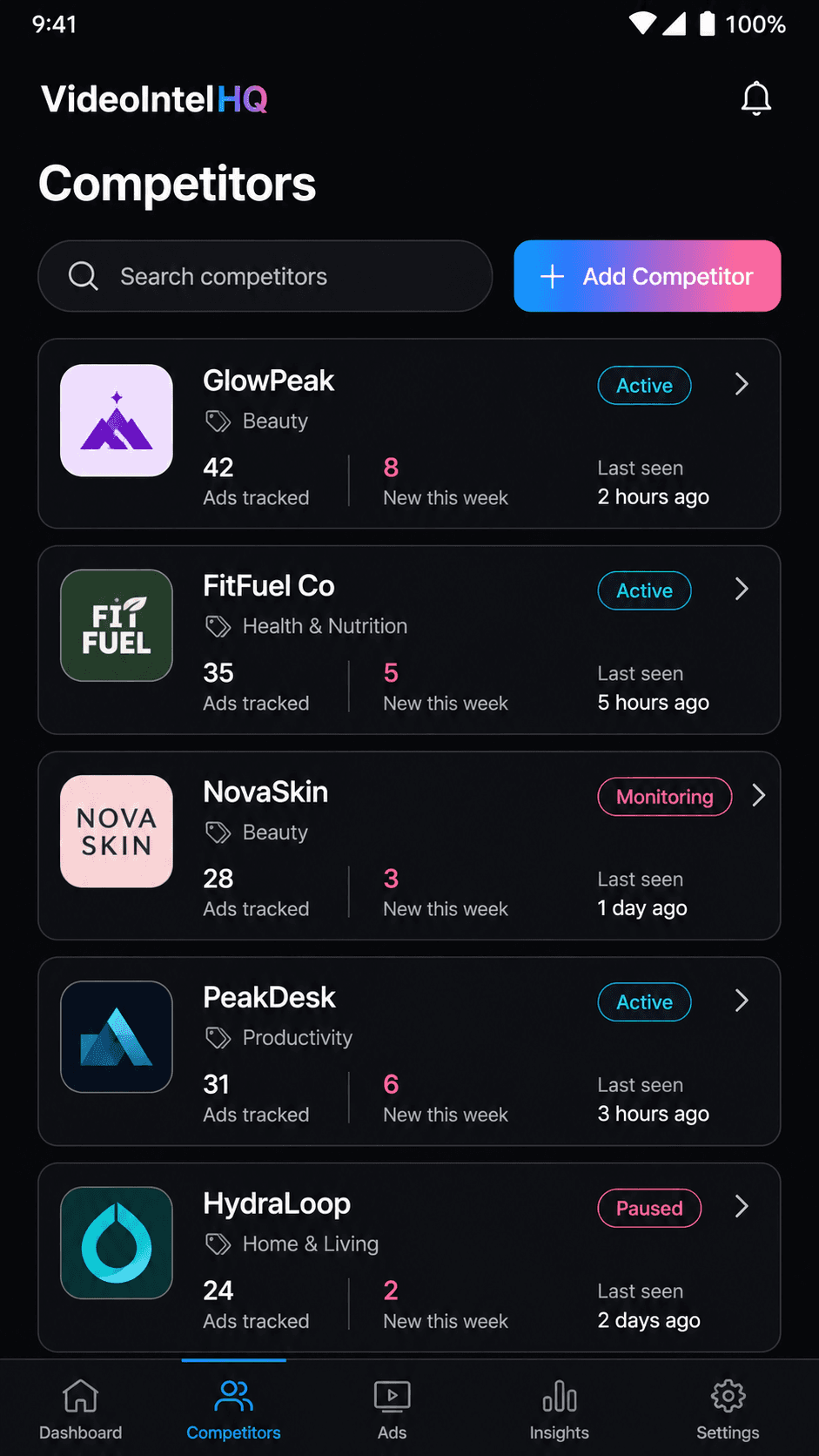
VideoIntelHQ supports this kind of resource by giving teams a dashboard for competitor video ad tracking, public creative signals, hook change tracking, offer shift alerts, creative pattern notes, and weekly campaign summaries. The product is designed to keep research organized and reviewable. It is not a shortcut for copying ads, scraping private data, bypassing ad platform rules, or promising campaign results.
Template fields
Examples by team type
Agencies
Use dtc creative research checklist to prepare client-ready weekly notes that explain what changed, why it might matter, and what the next review or brief should cover.
DTC brands
Use dtc creative research checklist to compare public creative signals against your own product, offer, landing page, and customer research before deciding what to test.
Creative strategists
Use dtc creative research checklist to turn scattered inspiration into organized hook, offer, proof, format, and destination-page notes for original briefs.
Media buyers
Use dtc creative research checklist as context before creative testing and budget discussions, while avoiding unsupported claims about private ROAS, revenue, conversions, or campaign outcomes.
Build from the research
Turn this research into a short-form video workflow.
Use this guide to understand the signal, then use the Vertical Video Growth Operating System to create hooks, scripts, publishing plans, reviews, and next actions with AI.
Common mistakes to avoid
Saving examples without a review date or source context
Using competitor ads as scripts to copy rather than patterns to interpret
Presenting public visibility as proof of private campaign performance
Ignoring landing page alignment when reviewing video creative
Creating a long report without a clear next action
FAQ
Can I use this resource for client reporting?
Yes. Keep visible observations separate from interpretation and include caveats that public ad signals are planning inputs, not private performance evidence.
Should every ad go into the template?
No. Save examples that reveal a relevant hook, offer, format, proof point, landing-page promise, or market shift. Archive low-signal examples.
How does VideoIntelHQ fit with this template?
VideoIntelHQ gives teams a dashboard for tracking competitors, organizing hooks and offers, and turning public creative signals into weekly summaries.
Related resources
Turn research templates into a repeatable dashboard workflow.
VideoIntelHQ helps teams move from manual files to organized competitor watchlists, hook notes, offer notes, and weekly creative summaries.
VideoIntelHQ helps organize public creative research signals. It does not guarantee ad performance, revenue, ROAS, conversions, sales, or campaign outcomes.